The Social Skills Debugger: A Self-Assessment Guide for Engineers
You know that feeling when your code isn’t working quite right, but you can’t immediately pinpoint the issue? You run some diagnostics, check the logs, maybe add some debug statements, and gradually build a picture of what’s actually happening versus what you thought was happening.
Social skills work the same way. Many engineers suspect their interpersonal “code” could use some optimization, but they lack the debugging tools to figure out exactly where the issues lie. Unlike technical skills, where broken code announces itself with error messages, social skill gaps tend to manifest as vague feelings of disconnection, missed opportunities, or mysterious career plateaus.
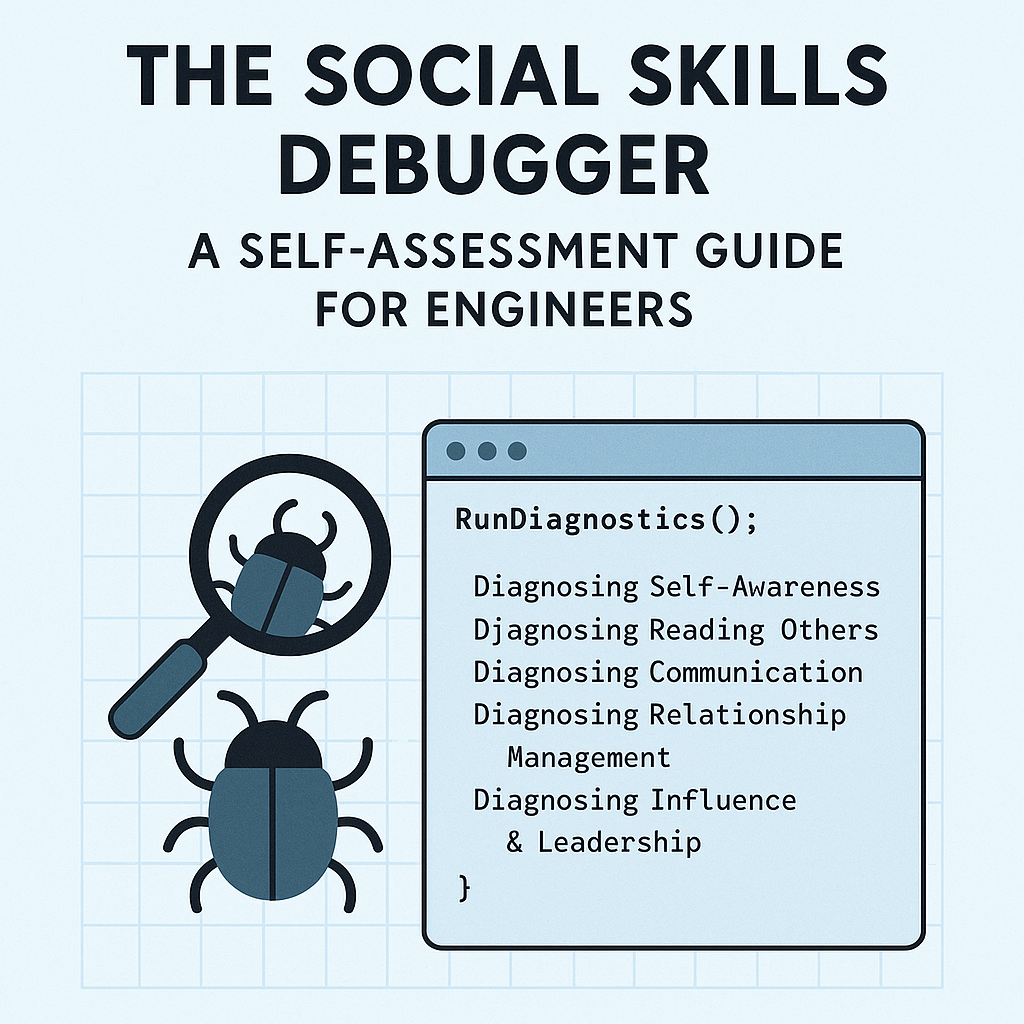
Today, we’re going to build a comprehensive social skills debugger—a systematic way to assess your current interpersonal capabilities and identify specific areas for improvement. Think of it as running a full diagnostic suite on your human interaction protocols.
Why Traditional Social Skills Assessments Don’t Work for Engineers
Most social skills assessments out there are built for general audiences and tend to be frustratingly vague. They’ll tell you things like “you need to be more empathetic” or “work on your communication skills”—the equivalent of a compiler error that just says “something is wrong somewhere.”
Engineers need specificity. We need to know:
- What exactly is broken?
- Under what conditions does it fail?
- What’s the root cause?
- What’s the priority order for fixes?
- How do we measure improvement?
So let’s build a diagnostic tool that actually provides actionable data.
Take the social skills assessment now.
The Social Skills Stack Trace
Just as you might analyze a system’s performance at different layers, we’ll examine your social skills across several key domains:
Layer 1: Self-Awareness (Your Internal APIs)
How well do you understand your own social operating system?
Layer 2: Reading Others (Input Processing)
How accurately do you interpret social signals and context?
Layer 3: Communication (Output Generation)
How effectively do you express ideas and respond to others?
Layer 4: Relationship Management (System Integration)
How well do you build and maintain connections over time?
Layer 5: Influence & Leadership (Advanced Operations)
How effectively can you guide group dynamics and drive outcomes?
Let’s run diagnostics on each layer.
Layer 1 Diagnostics: Self-Awareness Assessment
Start with introspection. Answer these questions honestly—this is your private debugging session.
Emotional State Monitoring
Rate yourself (1-5 scale) on how well you:
- Notice when your mood changes during the day
- Understand what triggers stress or frustration for you
- Recognize when you’re becoming defensive in conversations
- Identify your energy levels and how they affect your interactions
Debug prompt: Think of a recent meeting that didn’t go well. Can you identify what you were feeling during that meeting and how it might have affected your behavior?
Social Preference Profiling
Rate yourself on how clearly you understand your:
- Optimal group size for different types of interactions
- Communication style preferences (direct vs. diplomatic, detailed vs. high-level)
- Conflict resolution tendencies (avoid, confront, delegate)
- Networking comfort zones and energy drains
Debug prompt: Consider your last team social event. What aspects energized you versus drained you? This reveals important data about your social operating parameters.
Impact Awareness
Rate yourself on how well you understand:
- How your communication style affects different personality types
- What your “default” persona is in professional settings
- How others typically describe your working style
- When your technical expertise might intimidate or alienate others
Debug prompt: Ask yourself: If someone described my communication style to a new team member, what would they likely say?
Layer 2 Diagnostics: Reading Others Assessment
This layer tests your ability to accurately interpret social data from your environment.
Nonverbal Signal Processing
Rate your ability to:
- Notice when someone’s body language doesn’t match their words
- Recognize signs of confusion, frustration, or disengagement in meetings
- Identify when someone wants to speak but hasn’t found an opening
- Pick up on energy shifts in group dynamics
Debug test: In your next meeting, try to identify one person’s emotional state based purely on nonverbal cues. Later, check your assessment by asking how they’re doing.
Context Sensitivity
Rate your skill at:
- Adjusting your communication style based on the audience
- Recognizing when a conversation has become politically sensitive
- Understanding unspoken organizational dynamics that affect decisions
- Sensing when timing is wrong for certain discussions
Debug test: Think of a recent proposal that was rejected. Was there context you missed about timing, politics, or stakeholder concerns?
Empathy Engine Performance
Rate your ability to:
- Understand why someone might disagree with your technical assessment
- Recognize when someone is struggling with concepts you find obvious
- Anticipate what information different stakeholders will find compelling
- See situations from perspectives very different from your own
Debug test: Next time you’re in a technical discussion, pause and try to articulate the other person’s concerns or constraints in their own words.
Layer 3 Diagnostics: Communication Assessment
This tests your output generation and response systems.
Technical Translation Capabilities
Rate your skill at:
- Explaining complex technical concepts to non-technical audiences
- Adapting your level of detail based on the listener’s background
- Using analogies and metaphors that resonate with different audiences
- Highlighting the business impact of technical decisions
Debug test: Try explaining your current project to someone outside your field. Notice where they look confused and adjust in real-time.
Feedback Delivery & Reception
Rate your ability to:
- Provide constructive criticism without triggering defensiveness
- Receive feedback without becoming defensive yourself
- Ask clarifying questions when you disagree with input
- Separate criticism of your ideas from criticism of your competence
Debug test: Recall the last time you had to give critical feedback. Did the person become defensive? If so, how might your delivery have contributed to that response?
Conflict Navigation
Rate your skill at:
- Addressing disagreements directly but diplomatically
- Finding common ground when opinions diverge
- De-escalating tense situations
- Maintaining relationships through professional disagreements
Debug test: Think of a recent conflict. Did it get resolved in a way that strengthened or weakened the working relationship?
Layer 4 Diagnostics: Relationship Management Assessment
This evaluates your ability to build and maintain professional connections over time.
Network Maintenance
Rate your effectiveness at:
- Staying in touch with colleagues who’ve moved to other teams/companies
- Building relationships before you need them
- Remembering personal details about colleagues’ lives and interests
- Following up on conversations and commitments
Debug test: When was the last time you reached out to a former colleague just to check in? How does your professional network look beyond your immediate team?
Trust Building
Rate your ability to:
- Following through consistently on commitments
- Admitting when you don’t know something
- Sharing credit generously for team successes
- Being reliable in both small and large matters
Debug test: Think of someone who trusts your technical judgment. What specific behaviors built that trust?
Collaborative Dynamics
Rate your skill at:
- Including quieter team members in discussions
- Building on others’ ideas rather than just presenting your own
- Navigating personality differences productively
- Creating psychological safety for your teammates
Debug test: In team meetings, do you tend to speak first or wait to hear others? What’s the effect of your typical participation pattern?
Layer 5 Diagnostics: Influence & Leadership Assessment
This tests advanced social capabilities around guiding groups and driving outcomes.
Persuasion & Influence
Rate your ability to:
- Building compelling cases for technical decisions that include non-technical factors
- Getting buy-in from stakeholders who initially disagree
- Influencing without formal authority
- Timing proposals for maximum receptivity
Debug test: Think of your most successful technical proposal. What made it successful beyond just the technical merit?
Group Dynamics Management
Rate your skill at:
- Facilitating productive technical discussions
- Preventing meetings from going off track
- Ensuring all voices are heard in decision-making
- Building consensus around complex technical trade-offs
Debug test: In your last team meeting, what was your role in the group dynamic? Did you help the conversation or remain passive?
Mentoring & Development
Rate your ability to:
- Explaining not just what to do but why
- Providing guidance that helps others grow
- Recognizing and nurturing potential in junior colleagues
- Creating learning opportunities for your team
Debug test: Think of someone you’ve mentored. What feedback have they given you about your mentoring style?
Generating Your Social Skills Report
Now, compile your diagnostic results:
Identify Your Strongest Areas
Which layers showed consistently high ratings? These are your social skills strengths—the equivalent of well-optimized code that runs smoothly. These areas can become:
- Leverage points for expanding your influence
- Mentoring opportunities for others
- Confidence builders when taking on new challenges
Pinpoint Critical Issues
Which areas showed consistently low ratings or revealed significant gaps? These are your priority debugging targets. Focus on:
- Issues that directly impact your current role effectiveness
- Skills that would unlock your next career level
- Capabilities that align with your personal development goals
Spot Inconsistent Performance
Are there areas where your self-assessment varies dramatically depending on context? This suggests conditional bugs—social skills that work well in some environments but fail in others. For example:
- Great at technical discussions but struggle in client meetings
- Effective in small groups but ineffective in large meetings
- Strong with peers but struggle with authority figures
The Debugging Action Plan
Based on your diagnostic results, create a targeted improvement plan:
Pick One Layer to Focus On
Don’t try to fix everything at once. Choose the layer where improvement would have the biggest impact on your current role or career goals.
Define Specific, Measurable Improvements
Instead of “improve communication,” try:
- “Confirm understanding in 80% of technical explanations by asking for feedback”
- “Send weekly project updates that connect technical work to business value”
- “Have one substantive conversation with a colleague outside my team each week”
Create Feedback Loops
Build mechanisms to monitor your improvement:
- Ask trusted colleagues for specific feedback
- Self-assess after important conversations
- Track metrics that matter (meeting effectiveness, project buy-in, relationship quality)
Establish Regular Review Cycles
Schedule monthly “social skills retrospectives” where you:
- Review what communication approaches worked well
- Identify patterns in challenging interactions
- Adjust your development focus based on new data
The Ongoing Monitoring System
Just as you wouldn’t deploy code and never monitor its performance, don’t implement social skills improvements without ongoing measurement:
Weekly Check-ins
- What social interactions went well this week?
- Where did I struggle or feel uncomfortable?
- What patterns am I noticing in my communication?
Monthly Analysis
- Am I making progress on my targeted improvement area?
- What new social skills challenges have emerged?
- How are my relationships evolving?
Quarterly Reassessment
- Re-run portions of this diagnostic to measure progress
- Adjust focus areas based on new career demands
- Celebrate improvements and identify next development priorities
When to Seek External Input
Sometimes self-assessment has limitations, just like trying to debug your own code. Consider getting external perspective when:
Your Self-Assessment Feels Uncertain
If you’re rating yourself as “3” on most items because you genuinely don’t know where you stand, seek feedback from trusted colleagues.
Patterns Keep Repeating
If you keep having the same types of social challenges despite your efforts, an outside perspective might reveal blind spots.
Stakes Are High
If you’re considering a role change, promotion, or major career shift, invest in professional feedback about your social skills readiness.
Conclusion: Social Skills as Continuous Integration
The most successful engineers I know treat social skills development like any other technical discipline—with curiosity, systematic improvement, and regular iteration. They understand that interpersonal effectiveness isn’t a fixed trait but a learnable skill set that improves with deliberate practice and honest feedback.
Your social skills debugging session is complete for now, but remember: this is an ongoing process. As your career evolves, new social challenges will emerge, requiring new capabilities and more sophisticated approaches to human interaction.
The good news? You already have the most important tool for social skills improvement: a systematic, analytical mindset. Apply it to the human domain, and you’ll be surprised how much your interpersonal “code” can be optimized.
Time to commit your changes and deploy the improved version of yourself.
Ready to work on specific social skills based on your assessment results? Check out our complete Engineering Social Skills series for targeted guidance on everything from small talk to leadership. Start with Why Are Engineers So Weird?