<?xml version="1.0" encoding="utf-8"?><feed xmlns="http://www.w3.org/2005/Atom" ><generator uri="https://jekyllrb.com/" version="4.3.4">Jekyll</generator><link href="https://engineeringsocialskills.com/feed.xml" rel="self" type="application/atom+xml" /><link href="https://engineeringsocialskills.com/" rel="alternate" type="text/html" /><updated>2025-07-16T00:05:06+00:00</updated><id>https://engineeringsocialskills.com/feed.xml</id><title type="html">Engineering Social Skills</title><subtitle>Advice on social skills for engineers and those seeking to be social butterflies.</subtitle><entry><title type="html">The Social Skills Debugger: A Self-Assessment Guide for Engineers</title><link href="https://engineeringsocialskills.com/social-skills-debugger/" rel="alternate" type="text/html" title="The Social Skills Debugger: A Self-Assessment Guide for Engineers" /><published>2025-06-28T00:00:00+00:00</published><updated>2025-06-28T00:00:00+00:00</updated><id>https://engineeringsocialskills.com/social-skills-debugger</id><content type="html" xml:base="https://engineeringsocialskills.com/social-skills-debugger/"><![CDATA[<script async="" src="https://pagead2.googlesyndication.com/pagead/js/adsbygoogle.js?client=ca-pub-9126627892561006" crossorigin="anonymous"></script>

<p>You know that feeling when your code isn’t working quite right, but you can’t immediately pinpoint the issue? You run some diagnostics, check the logs, maybe add some debug statements, and gradually build a picture of what’s actually happening versus what you thought was happening.</p>

<p>Social skills work the same way. Many engineers suspect their interpersonal “code” could use some optimization, but they lack the debugging tools to figure out exactly where the issues lie. Unlike technical skills, where broken code announces itself with error messages, social skill gaps tend to manifest as vague feelings of disconnection, missed opportunities, or mysterious career plateaus.</p>

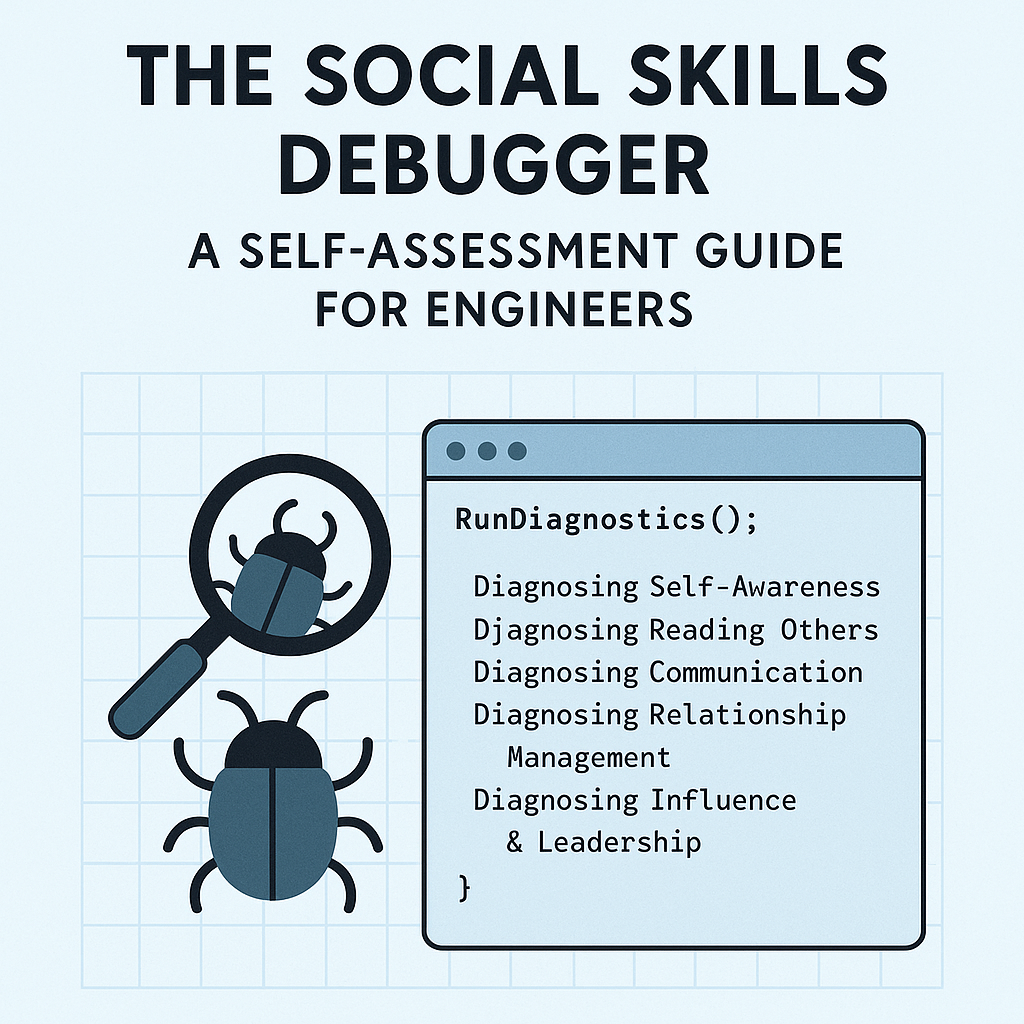
<p>Today, we’re going to build a comprehensive social skills debugger—a systematic way to assess your current interpersonal capabilities and identify specific areas for improvement. Think of it as running a full diagnostic suite on your human interaction protocols.</p>

<p><img src="/assets/SocialSkillsDebugger.png" alt="Why are engineers so weird? Use this social skills debugger to find out" /></p>

<h2 id="why-traditional-social-skills-assessments-dont-work-for-engineers">Why Traditional Social Skills Assessments Don’t Work for Engineers</h2>

<p>Most social skills assessments out there are built for general audiences and tend to be frustratingly vague. They’ll tell you things like “you need to be more empathetic” or “work on your communication skills”—the equivalent of a compiler error that just says “something is wrong somewhere.”</p>

<p>Engineers need specificity. We need to know:</p>
<ul>
  <li>What exactly is broken?</li>
  <li>Under what conditions does it fail?</li>
  <li>What’s the root cause?</li>
  <li>What’s the priority order for fixes?</li>
  <li>How do we measure improvement?</li>
</ul>

<p>So let’s build a diagnostic tool that actually provides actionable data.</p>

<p>Take the <a href="https://engineeringsocialskills.com/social-skills-debugger.html">social skills assessment</a> now.</p>

<h2 id="the-social-skills-stack-trace">The Social Skills Stack Trace</h2>

<p>Just as you might analyze a system’s performance at different layers, we’ll examine your social skills across several key domains:</p>

<h3 id="layer-1-self-awareness-your-internal-apis">Layer 1: Self-Awareness (Your Internal APIs)</h3>
<p>How well do you understand your own social operating system?</p>

<h3 id="layer-2-reading-others-input-processing">Layer 2: Reading Others (Input Processing)</h3>
<p>How accurately do you interpret social signals and context?</p>

<h3 id="layer-3-communication-output-generation">Layer 3: Communication (Output Generation)</h3>
<p>How effectively do you express ideas and respond to others?</p>

<h3 id="layer-4-relationship-management-system-integration">Layer 4: Relationship Management (System Integration)</h3>
<p>How well do you build and maintain connections over time?</p>

<h3 id="layer-5-influence--leadership-advanced-operations">Layer 5: Influence &amp; Leadership (Advanced Operations)</h3>
<p>How effectively can you guide group dynamics and drive outcomes?</p>

<p>Let’s run diagnostics on each layer.</p>

<h2 id="layer-1-diagnostics-self-awareness-assessment">Layer 1 Diagnostics: Self-Awareness Assessment</h2>

<p>Start with introspection. Answer these questions honestly—this is your private debugging session.</p>

<h3 id="emotional-state-monitoring">Emotional State Monitoring</h3>
<p>Rate yourself (1-5 scale) on how well you:</p>
<ul>
  <li>Notice when your mood changes during the day</li>
  <li>Understand what triggers stress or frustration for you</li>
  <li>Recognize when you’re becoming defensive in conversations</li>
  <li>Identify your energy levels and how they affect your interactions</li>
</ul>

<p><strong>Debug prompt</strong>: Think of a recent meeting that didn’t go well. Can you identify what you were feeling during that meeting and how it might have affected your behavior?</p>

<h3 id="social-preference-profiling">Social Preference Profiling</h3>
<p>Rate yourself on how clearly you understand your:</p>
<ul>
  <li>Optimal group size for different types of interactions</li>
  <li>Communication style preferences (direct vs. diplomatic, detailed vs. high-level)</li>
  <li>Conflict resolution tendencies (avoid, confront, delegate)</li>
  <li>Networking comfort zones and energy drains</li>
</ul>

<p><strong>Debug prompt</strong>: Consider your last team social event. What aspects energized you versus drained you? This reveals important data about your social operating parameters.</p>

<h3 id="impact-awareness">Impact Awareness</h3>
<p>Rate yourself on how well you understand:</p>
<ul>
  <li>How your communication style affects different personality types</li>
  <li>What your “default” persona is in professional settings</li>
  <li>How others typically describe your working style</li>
  <li>When your technical expertise might intimidate or alienate others</li>
</ul>

<p><strong>Debug prompt</strong>: Ask yourself: If someone described my communication style to a new team member, what would they likely say?</p>

<h2 id="layer-2-diagnostics-reading-others-assessment">Layer 2 Diagnostics: Reading Others Assessment</h2>

<p>This layer tests your ability to accurately interpret social data from your environment.</p>

<h3 id="nonverbal-signal-processing">Nonverbal Signal Processing</h3>
<p>Rate your ability to:</p>
<ul>
  <li>Notice when someone’s body language doesn’t match their words</li>
  <li>Recognize signs of confusion, frustration, or disengagement in meetings</li>
  <li>Identify when someone wants to speak but hasn’t found an opening</li>
  <li>Pick up on energy shifts in group dynamics</li>
</ul>

<p><strong>Debug test</strong>: In your next meeting, try to identify one person’s emotional state based purely on nonverbal cues. Later, check your assessment by asking how they’re doing.</p>

<h3 id="context-sensitivity">Context Sensitivity</h3>
<p>Rate your skill at:</p>
<ul>
  <li>Adjusting your communication style based on the audience</li>
  <li>Recognizing when a conversation has become politically sensitive</li>
  <li>Understanding unspoken organizational dynamics that affect decisions</li>
  <li>Sensing when timing is wrong for certain discussions</li>
</ul>

<p><strong>Debug test</strong>: Think of a recent proposal that was rejected. Was there context you missed about timing, politics, or stakeholder concerns?</p>

<h3 id="empathy-engine-performance">Empathy Engine Performance</h3>
<p>Rate your ability to:</p>
<ul>
  <li>Understand why someone might disagree with your technical assessment</li>
  <li>Recognize when someone is struggling with concepts you find obvious</li>
  <li>Anticipate what information different stakeholders will find compelling</li>
  <li>See situations from perspectives very different from your own</li>
</ul>

<p><strong>Debug test</strong>: Next time you’re in a technical discussion, pause and try to articulate the other person’s concerns or constraints in their own words.</p>

<h2 id="layer-3-diagnostics-communication-assessment">Layer 3 Diagnostics: Communication Assessment</h2>

<p>This tests your output generation and response systems.</p>

<h3 id="technical-translation-capabilities">Technical Translation Capabilities</h3>
<p>Rate your skill at:</p>
<ul>
  <li>Explaining complex technical concepts to non-technical audiences</li>
  <li>Adapting your level of detail based on the listener’s background</li>
  <li>Using analogies and metaphors that resonate with different audiences</li>
  <li>Highlighting the business impact of technical decisions</li>
</ul>

<p><strong>Debug test</strong>: Try explaining your current project to someone outside your field. Notice where they look confused and adjust in real-time.</p>

<h3 id="feedback-delivery--reception">Feedback Delivery &amp; Reception</h3>
<p>Rate your ability to:</p>
<ul>
  <li>Provide constructive criticism without triggering defensiveness</li>
  <li>Receive feedback without becoming defensive yourself</li>
  <li>Ask clarifying questions when you disagree with input</li>
  <li>Separate criticism of your ideas from criticism of your competence</li>
</ul>

<p><strong>Debug test</strong>: Recall the last time you had to give critical feedback. Did the person become defensive? If so, how might your delivery have contributed to that response?</p>

<h3 id="conflict-navigation">Conflict Navigation</h3>
<p>Rate your skill at:</p>
<ul>
  <li>Addressing disagreements directly but diplomatically</li>
  <li>Finding common ground when opinions diverge</li>
  <li>De-escalating tense situations</li>
  <li>Maintaining relationships through professional disagreements</li>
</ul>

<p><strong>Debug test</strong>: Think of a recent conflict. Did it get resolved in a way that strengthened or weakened the working relationship?</p>

<h2 id="layer-4-diagnostics-relationship-management-assessment">Layer 4 Diagnostics: Relationship Management Assessment</h2>

<p>This evaluates your ability to build and maintain professional connections over time.</p>

<h3 id="network-maintenance">Network Maintenance</h3>
<p>Rate your effectiveness at:</p>
<ul>
  <li>Staying in touch with colleagues who’ve moved to other teams/companies</li>
  <li>Building relationships before you need them</li>
  <li>Remembering personal details about colleagues’ lives and interests</li>
  <li>Following up on conversations and commitments</li>
</ul>

<p><strong>Debug test</strong>: When was the last time you reached out to a former colleague just to check in? How does your professional network look beyond your immediate team?</p>

<h3 id="trust-building">Trust Building</h3>
<p>Rate your ability to:</p>
<ul>
  <li>Following through consistently on commitments</li>
  <li>Admitting when you don’t know something</li>
  <li>Sharing credit generously for team successes</li>
  <li>Being reliable in both small and large matters</li>
</ul>

<p><strong>Debug test</strong>: Think of someone who trusts your technical judgment. What specific behaviors built that trust?</p>

<h3 id="collaborative-dynamics">Collaborative Dynamics</h3>
<p>Rate your skill at:</p>
<ul>
  <li>Including quieter team members in discussions</li>
  <li>Building on others’ ideas rather than just presenting your own</li>
  <li>Navigating personality differences productively</li>
  <li>Creating psychological safety for your teammates</li>
</ul>

<p><strong>Debug test</strong>: In team meetings, do you tend to speak first or wait to hear others? What’s the effect of your typical participation pattern?</p>

<h2 id="layer-5-diagnostics-influence--leadership-assessment">Layer 5 Diagnostics: Influence &amp; Leadership Assessment</h2>

<p>This tests advanced social capabilities around guiding groups and driving outcomes.</p>

<h3 id="persuasion--influence">Persuasion &amp; Influence</h3>
<p>Rate your ability to:</p>
<ul>
  <li>Building compelling cases for technical decisions that include non-technical factors</li>
  <li>Getting buy-in from stakeholders who initially disagree</li>
  <li>Influencing without formal authority</li>
  <li>Timing proposals for maximum receptivity</li>
</ul>

<p><strong>Debug test</strong>: Think of your most successful technical proposal. What made it successful beyond just the technical merit?</p>

<h3 id="group-dynamics-management">Group Dynamics Management</h3>
<p>Rate your skill at:</p>
<ul>
  <li>Facilitating productive technical discussions</li>
  <li>Preventing meetings from going off track</li>
  <li>Ensuring all voices are heard in decision-making</li>
  <li>Building consensus around complex technical trade-offs</li>
</ul>

<p><strong>Debug test</strong>: In your last team meeting, what was your role in the group dynamic? Did you help the conversation or remain passive?</p>

<h3 id="mentoring--development">Mentoring &amp; Development</h3>
<p>Rate your ability to:</p>
<ul>
  <li>Explaining not just what to do but why</li>
  <li>Providing guidance that helps others grow</li>
  <li>Recognizing and nurturing potential in junior colleagues</li>
  <li>Creating learning opportunities for your team</li>
</ul>

<p><strong>Debug test</strong>: Think of someone you’ve mentored. What feedback have they given you about your mentoring style?</p>

<h2 id="generating-your-social-skills-report">Generating Your Social Skills Report</h2>

<p>Now, compile your diagnostic results:</p>

<h3 id="identify-your-strongest-areas">Identify Your Strongest Areas</h3>
<p>Which layers showed consistently high ratings? These are your social skills strengths—the equivalent of well-optimized code that runs smoothly. These areas can become:</p>
<ul>
  <li>Leverage points for expanding your influence</li>
  <li>Mentoring opportunities for others</li>
  <li>Confidence builders when taking on new challenges</li>
</ul>

<h3 id="pinpoint-critical-issues">Pinpoint Critical Issues</h3>
<p>Which areas showed consistently low ratings or revealed significant gaps? These are your priority debugging targets. Focus on:</p>
<ul>
  <li>Issues that directly impact your current role effectiveness</li>
  <li>Skills that would unlock your next career level</li>
  <li>Capabilities that align with your personal development goals</li>
</ul>

<h3 id="spot-inconsistent-performance">Spot Inconsistent Performance</h3>
<p>Are there areas where your self-assessment varies dramatically depending on context? This suggests conditional bugs—social skills that work well in some environments but fail in others. For example:</p>
<ul>
  <li>Great at technical discussions but struggle in client meetings</li>
  <li>Effective in small groups but ineffective in large meetings</li>
  <li>Strong with peers but struggle with authority figures</li>
</ul>

<h2 id="the-debugging-action-plan">The Debugging Action Plan</h2>

<p>Based on your diagnostic results, create a targeted improvement plan:</p>

<h3 id="pick-one-layer-to-focus-on">Pick One Layer to Focus On</h3>
<p>Don’t try to fix everything at once. Choose the layer where improvement would have the biggest impact on your current role or career goals.</p>

<h3 id="define-specific-measurable-improvements">Define Specific, Measurable Improvements</h3>
<p>Instead of “improve communication,” try:</p>
<ul>
  <li>“Confirm understanding in 80% of technical explanations by asking for feedback”</li>
  <li>“Send weekly project updates that connect technical work to business value”</li>
  <li>“Have one substantive conversation with a colleague outside my team each week”</li>
</ul>

<h3 id="create-feedback-loops">Create Feedback Loops</h3>
<p>Build mechanisms to monitor your improvement:</p>
<ul>
  <li>Ask trusted colleagues for specific feedback</li>
  <li>Self-assess after important conversations</li>
  <li>Track metrics that matter (meeting effectiveness, project buy-in, relationship quality)</li>
</ul>

<h3 id="establish-regular-review-cycles">Establish Regular Review Cycles</h3>
<p>Schedule monthly “social skills retrospectives” where you:</p>
<ul>
  <li>Review what communication approaches worked well</li>
  <li>Identify patterns in challenging interactions</li>
  <li>Adjust your development focus based on new data</li>
</ul>

<h2 id="the-ongoing-monitoring-system">The Ongoing Monitoring System</h2>

<p>Just as you wouldn’t deploy code and never monitor its performance, don’t implement social skills improvements without ongoing measurement:</p>

<h3 id="weekly-check-ins">Weekly Check-ins</h3>
<ul>
  <li>What social interactions went well this week?</li>
  <li>Where did I struggle or feel uncomfortable?</li>
  <li>What patterns am I noticing in my communication?</li>
</ul>

<h3 id="monthly-analysis">Monthly Analysis</h3>
<ul>
  <li>Am I making progress on my targeted improvement area?</li>
  <li>What new social skills challenges have emerged?</li>
  <li>How are my relationships evolving?</li>
</ul>

<h3 id="quarterly-reassessment">Quarterly Reassessment</h3>
<ul>
  <li>Re-run portions of this diagnostic to measure progress</li>
  <li>Adjust focus areas based on new career demands</li>
  <li>Celebrate improvements and identify next development priorities</li>
</ul>

<h2 id="when-to-seek-external-input">When to Seek External Input</h2>

<p>Sometimes self-assessment has limitations, just like trying to debug your own code. Consider getting external perspective when:</p>

<h3 id="your-self-assessment-feels-uncertain">Your Self-Assessment Feels Uncertain</h3>
<p>If you’re rating yourself as “3” on most items because you genuinely don’t know where you stand, seek feedback from trusted colleagues.</p>

<h3 id="patterns-keep-repeating">Patterns Keep Repeating</h3>
<p>If you keep having the same types of social challenges despite your efforts, an outside perspective might reveal blind spots.</p>

<h3 id="stakes-are-high">Stakes Are High</h3>
<p>If you’re considering a role change, promotion, or major career shift, invest in professional feedback about your social skills readiness.</p>

<h2 id="conclusion-social-skills-as-continuous-integration">Conclusion: Social Skills as Continuous Integration</h2>

<p>The most successful engineers I know treat social skills development like any other technical discipline—with curiosity, systematic improvement, and regular iteration. They understand that interpersonal effectiveness isn’t a fixed trait but a learnable skill set that improves with deliberate practice and honest feedback.</p>

<p>Your social skills debugging session is complete for now, but remember: this is an ongoing process. As your career evolves, new social challenges will emerge, requiring new capabilities and more sophisticated approaches to human interaction.</p>

<p>The good news? You already have the most important tool for social skills improvement: a systematic, analytical mindset. Apply it to the human domain, and you’ll be surprised how much your interpersonal “code” can be optimized.</p>

<p>Time to commit your changes and deploy the improved version of yourself.</p>

<p><em>Ready to work on specific social skills based on your assessment results? Check out our complete Engineering Social Skills series for targeted guidance on everything from small talk to leadership. Start with <a href="https://engineeringsocialskills.com/why-are-engineers-so-weird/">Why Are Engineers So Weird?</a></em></p>

<hr />]]></content><author><name></name></author><summary type="html"><![CDATA[Debug your social skills like code! A self-assessment guide for engineers to improve communication, empathy, and leadership.]]></summary></entry><entry><title type="html">The Engineer’s Child: Common Traits, Hidden Challenges, and How to Navigate Them</title><link href="https://engineeringsocialskills.com/engineers-child/" rel="alternate" type="text/html" title="The Engineer’s Child: Common Traits, Hidden Challenges, and How to Navigate Them" /><published>2025-06-21T00:00:00+00:00</published><updated>2025-06-21T00:00:00+00:00</updated><id>https://engineeringsocialskills.com/engineers-child</id><content type="html" xml:base="https://engineeringsocialskills.com/engineers-child/"><![CDATA[<script async="" src="https://pagead2.googlesyndication.com/pagead/js/adsbygoogle.js?client=ca-pub-9126627892561006" crossorigin="anonymous"></script>

<p>If you’re an engineer with children, you’ve probably noticed some interesting patterns. Maybe your five-year-old methodically takes apart every toy to understand its mechanism. Perhaps your teenager approaches problems with an almost scientific precision that both impresses and occasionally frustrates you. These aren’t coincidences—children of engineers often develop distinct characteristics that reflect both genetic predispositions and environmental influences.</p>

<p>Understanding these patterns can help engineer parents leverage their children’s strengths while addressing potential blind spots that could impact their social and emotional development.</p>

<p><img src="/assets/EngineerChild.png" alt="an image of a smart child taking apart a toy to understand how it works" /></p>

<h2 id="the-common-thread-analytical-minds-in-small-bodies">The Common Thread: Analytical Minds in Small Bodies</h2>

<p>Research on engineer personality traits reveals several key characteristics that often appear in their children: curiosity, critical thinking, creativity, effective communication, and a collaborative spirit. Additionally, engineers typically exhibit goal-oriented, serious-minded, and conscientious behavior, with a fundamental aversion to ambiguity and analytical, confident, and dependable personalities.</p>

<p>Children growing up in engineer households frequently display these inherited and learned traits:</p>

<p><strong>Systematic Problem-Solving</strong>: These children often approach challenges methodically, breaking down complex problems into manageable components. They’re the kids who will spend hours figuring out why their Lego creation keeps falling over, testing different configurations until they find the optimal solution.</p>

<p><strong>High Curiosity Drive</strong>: Children who spend hours taking apart toys just to see how they work are the kind of kids who grow up to be engineers. This trait often manifests early and intensely in engineers’ children.</p>

<p><strong>Preference for Logic Over Emotion</strong>: These children tend to approach interpersonal conflicts with the same analytical mindset they apply to technical problems, sometimes missing the emotional nuances that drive human behavior.</p>

<p><strong>Perfectionist Tendencies</strong>: The engineering emphasis on precision and optimization often translates into children who set extremely high standards for themselves and can become frustrated when results don’t match their expectations.</p>

<p><strong>Independence in Learning</strong>: Many engineers’ children develop strong self-directed learning habits, preferring to figure things out themselves rather than asking for help.</p>

<h2 id="the-double-edged-advantages">The Double-Edged Advantages</h2>

<p>These traits create significant advantages in academic and technical pursuits. Engineers’ children often excel in STEM subjects, demonstrate advanced problem-solving capabilities, and develop strong analytical thinking skills early. Their methodical approach to learning can lead to deep understanding of complex concepts.</p>

<p>However, the same traits that drive academic success can create social and emotional challenges. The preference for logical thinking over emotional processing can make it difficult for these children to navigate the inherently illogical world of human relationships. Their perfectionist tendencies, while driving excellence, can also lead to anxiety and fear of failure.</p>

<h2 id="where-engineer-parents-can-do-better">Where Engineer Parents Can Do Better</h2>

<p>Authoritative parenting is associated with at least one positive outcome in every region of the world, while authoritarian parenting is associated with at least one negative child outcome. For engineer parents, this research is particularly relevant because their natural tendencies toward structure and problem-solving can sometimes veer into overly authoritarian territory.</p>

<p><strong>Balance Structure with Emotional Validation</strong>: While your instinct might be to solve your child’s problems or provide logical explanations for their emotions, sometimes they just need acknowledgment of their feelings. “That sounds really frustrating” can be more helpful than immediately jumping to solutions.</p>

<p><strong>Model Emotional Intelligence</strong>: Make your own emotional processing visible. When you’re stressed about a project deadline, verbalize both the logical concerns and the emotional impact: “I’m worried about this deadline because I want to deliver quality work, and that pressure is making me feel anxious.”</p>

<p><strong>Encourage “Inefficient” Play</strong>: Not every activity needs to have a clear learning objective or optimal outcome. Unstructured play, creative mess-making, and seemingly “pointless” social activities are crucial for developing emotional intelligence and social skills.</p>

<p><strong>Teach the Value of “Good Enough”</strong>: Engineers often optimize for perfection, but children need to learn when 80% is sufficient. Help them identify when additional effort provides diminishing returns.</p>

<p><strong>Invest in Social Skills Training</strong>: Just as you might invest in STEM camps or coding classes, consider social skills development as equally important. Drama classes, team sports, or group activities can provide structured practice in areas that don’t come naturally.</p>

<h2 id="what-engineer-children-should-watch-out-for">What Engineer Children Should Watch Out For</h2>

<p>If you’re reading this as someone who grew up with engineer parents or recognizes these traits in yourself, here are key areas for self-awareness and growth:</p>

<p><strong>The Analysis Paralysis Trap</strong>: Your tendency to thoroughly analyze situations can sometimes prevent you from taking action or making decisions when incomplete information is normal and acceptable.</p>

<p><strong>Emotional Blind Spots</strong>: You might miss important social cues or dismiss emotional concerns (your own or others’) as “illogical.” Remember that emotions provide valuable data about relationships and situations.</p>

<p><strong>Perfectionism Paralysis</strong>: Your high standards can become self-defeating when they prevent you from starting projects, submitting work, or taking social risks because the outcome might not be perfect.</p>

<p><strong>Communication Assumptions</strong>: You might assume others share your preference for direct, logical communication and miss the importance of context, tone, and emotional subtext in human interactions.</p>

<p><strong>Social Energy Management</strong>: If you’re naturally introverted like many engineers, you need to actively budget energy for social interactions and relationship maintenance.</p>

<h2 id="strategies-for-success">Strategies for Success</h2>

<p><strong>Develop Emotional Vocabulary</strong>: Practice identifying and naming emotions—both your own and others’. This creates the foundation for emotional intelligence that complements your analytical skills.</p>

<p><strong>Embrace Iterative Social Learning</strong>: Apply your systematic learning approach to social skills. Observe social interactions, hypothesize about what works, test approaches, and refine based on results.</p>

<p><strong>Seek Diverse Perspectives</strong>: Actively cultivate relationships with people who think differently than you do. Their viewpoints will challenge your assumptions and broaden your problem-solving toolkit.</p>

<p><strong>Practice Imperfection</strong>: Set aside time for activities where the goal is exploration rather than optimization. Try creative pursuits, sports, or hobbies where “failure” is part of the learning process.</p>

<p><strong>Build Your Support Network</strong>: Recognize that asking for help—especially with emotional or social challenges—is a sign of good engineering judgment, not weakness.</p>

<h2 id="the-bottom-line">The Bottom Line</h2>

<p>Children of engineers inherit remarkable analytical capabilities and problem-solving skills that serve them well throughout life. However, these same traits can create blind spots in emotional intelligence and social navigation if left unaddressed.</p>

<p>The key is recognizing that human relationships and emotional well-being operate on different principles than technical systems. They require different tools, different metrics for success, and different approaches to optimization.</p>

<p>By acknowledging both the strengths and potential challenges of the “engineer child” profile, parents can better support their children’s development, and adult children of engineers can better understand and address their own growth areas. The goal isn’t to eliminate these analytical traits—they’re genuine superpowers—but to complement them with emotional intelligence and social skills that create well-rounded, successful individuals.</p>

<p>After all, the best engineers aren’t just technical experts—they’re people who can solve complex problems while building strong relationships and leading effective teams. These skills start developing in childhood, and they’re just as learnable as any other engineering discipline.</p>

<hr />]]></content><author><name></name></author><summary type="html"><![CDATA[Engineer parents: Understand your child's unique traits & challenges. Nurture their strengths, build emotional intelligence for well-rounded success.]]></summary></entry><entry><title type="html">The Science of Connection: How Good Communication Skills Boost Your Health</title><link href="https://engineeringsocialskills.com/social-skills-and-health/" rel="alternate" type="text/html" title="The Science of Connection: How Good Communication Skills Boost Your Health" /><published>2025-06-14T00:00:00+00:00</published><updated>2025-06-14T00:00:00+00:00</updated><id>https://engineeringsocialskills.com/social-skills-and-health</id><content type="html" xml:base="https://engineeringsocialskills.com/social-skills-and-health/"><![CDATA[<script async="" src="https://pagead2.googlesyndication.com/pagead/js/adsbygoogle.js?client=ca-pub-9126627892561006" crossorigin="anonymous"></script>

<p>As engineers, we’re accustomed to thinking about systems, optimization, and measurable outcomes. What if I told you that your communication skills are one of the most powerful tools you have for optimizing your own health? The research is clear: good communication isn’t just nice to have—it’s a critical component of physical and mental well-being.</p>

<p><img src="/assets/CommunicationAndHealth.png" alt="an image that illustrates the connection between communication and health" /></p>

<h2 id="the-numbers-dont-lie">The Numbers Don’t Lie</h2>

<p>The statistics around communication and health are striking. The US Surgeon General’s Advisory posits that the mortality impact of lacking social connection is akin to that of smoking up to 15 cigarettes per day, surpassing even the risks associated with obesity and physical inactivity. This isn’t hyperbole—it’s based on rigorous meta-analyses of health data from millions of people.</p>

<p>In the workplace, the health impacts are equally measurable. 43% of survey respondents have experienced burnout, stress, and fatigue due to workplace communication issues. Meanwhile, effective communication improves productivity by 25% when employees feel more engaged with their work and connected with their colleagues. Better productivity means less stress, fewer late nights, and more time for the activities that support your well-being.</p>

<h2 id="how-communication-affects-your-body">How Communication Affects Your Body</h2>

<p>Good communication skills create measurable physiological benefits. When we have strong social connections facilitated by effective communication, our bodies respond in remarkable ways. Research shows that people with robust social networks have lower levels of stress hormones like cortisol, reduced inflammation markers, and stronger immune responses.</p>

<p>Social isolation and loneliness can increase a person’s risk for: Heart disease and stroke. Type 2 diabetes. Depression and anxiety. Suicidality and self-harm… Earlier death. Conversely, strong communication skills help us build the social connections that protect against these very health risks.</p>

<p>The cardiovascular benefits alone are significant. Loneliness itself has been linked with increased risk of cardiovascular disease and mortality, elevated blood pressure and cortisol, heightened inflammatory responses to stress, and modifications in transcriptional pathways linked with glucocorticoid and inflammatory responses. Good communication skills help us avoid this loneliness trap by enabling meaningful connections with colleagues, friends, and family.</p>

<h2 id="a-story-from-the-trenches">A Story from the Trenches</h2>

<p>Let me share the story of Sarah, a senior software architect I worked with at a previous company. Sarah was brilliant—she could design complex distributed systems in her sleep—but she struggled with team communication. She’d skip daily standups, avoid one-on-ones with her manager, and communicate primarily through terse Slack messages.</p>

<p>Over the course of a year, I watched Sarah’s health deteriorate. She was constantly stressed, frequently sick, and eventually developed what her doctor diagnosed as stress-induced hypertension. Her manager was considering moving her off critical projects, which only increased her anxiety.</p>

<p>The turning point came when Sarah decided to work on her communication skills systematically. She started small: asking clarifying questions in meetings, scheduling brief coffee chats with teammates, and being more descriptive in her written communications. Within six months, something remarkable happened.</p>

<p>Not only did her relationships at work improve dramatically, but her health markers did too. Her blood pressure normalized, she was taking fewer sick days, and she reported sleeping better. The promotion she received nine months later was almost secondary to the health transformation. Sarah had discovered what the research confirms: good communication skills are preventive medicine.</p>

<h2 id="the-professional-health-connection">The Professional Health Connection</h2>

<p>In healthcare settings, the data is particularly compelling. Good communication can also lower the risk of malpractice claims while improving patient outcomes. Communication helps providers bond with patients, forming therapeutic relationships that benefit patient-centred outcomes. This principle applies beyond healthcare—when we communicate well with our teams, we reduce conflict, build trust, and create psychologically safer work environments.</p>

<p>For engineers specifically, good communication skills protect against one of our profession’s biggest health risks: chronic isolation. When we can articulate our ideas clearly, collaborate effectively, and navigate workplace relationships successfully, we’re less likely to become the stereotypical “hermit programmer” whose health suffers from social disconnection.</p>

<h2 id="the-training-gap">The Training Gap</h2>

<p>Here’s what’s concerning: Only 57% of participants had participated in health communication training, while 88.1% of them indicated a willingness to be trained in health communication. This gap suggests that many of us recognize the importance of communication skills but haven’t found the right resources or prioritized the investment.</p>

<h2 id="building-your-communication-immune-system">Building Your Communication Immune System</h2>

<p>Think of communication skills as your social immune system. Just as you maintain your physical health through exercise and nutrition, you can maintain your social health through deliberate communication practice. This might include active listening exercises, joining professional speaking groups, seeking feedback on your communication style, or simply committing to having more face-to-face conversations with colleagues.</p>

<p>The beauty of this approach is that it creates a positive feedback loop. Better communication leads to stronger relationships, which improve your health, which gives you more energy and confidence to communicate even more effectively.</p>

<h2 id="the-bottom-line">The Bottom Line</h2>

<p>For engineers, investing in communication skills isn’t just about career advancement—it’s about longevity, stress reduction, and overall health optimization. The data is clear: social connection is as important for your health as diet and exercise. And good communication skills are the key to building those connections.</p>

<p>Your ability to debug code and design systems is impressive, but your ability to connect with other humans might be the most important system you ever optimize.</p>

<hr />]]></content><author><name></name></author><summary type="html"><![CDATA[Engineers: Boost your health! Good communication prevents loneliness, reduces stress & chronic disease. Optimize your well-being.]]></summary></entry><entry><title type="html">The Hidden Cost: How Poor Social Skills Fuel Depression in Engineers</title><link href="https://engineeringsocialskills.com/link-between-social-skills-and-depression/" rel="alternate" type="text/html" title="The Hidden Cost: How Poor Social Skills Fuel Depression in Engineers" /><published>2025-06-07T00:00:00+00:00</published><updated>2025-06-07T00:00:00+00:00</updated><id>https://engineeringsocialskills.com/link-between-social-skills-and-depression</id><content type="html" xml:base="https://engineeringsocialskills.com/link-between-social-skills-and-depression/"><![CDATA[<script async="" src="https://pagead2.googlesyndication.com/pagead/js/adsbygoogle.js?client=ca-pub-9126627892561006" crossorigin="anonymous"></script>

<p>As engineers, we’re trained to solve complex problems, debug intricate systems, and build innovative solutions. But there’s one critical system many of us struggle to navigate: human relationships. The consequences of underdeveloped social skills extend far beyond awkward small talk or missed networking opportunities—they can significantly impact our mental health and contribute to depression.</p>

<p><img src="/assets/DepressedEngineer.png" alt="an image of an engineer looking isolated and sad in front of a computer" /></p>

<h2 id="the-isolation-spiral">The Isolation Spiral</h2>

<p>Poor interpersonal skills often create a self-reinforcing cycle of isolation. When we struggle to connect with colleagues, express our ideas clearly, or navigate office dynamics, we tend to withdraw. This withdrawal feels safer in the moment, but it gradually cuts us off from the social support systems that are crucial for psychological well-being.</p>

<p>Engineers are particularly vulnerable to this pattern because our work often allows for—and sometimes even rewards—solitary focus. We can spend entire days problem-solving alone, which can mask the growing gap between our technical abilities and our social capabilities.</p>

<h2 id="the-professional-toll">The Professional Toll</h2>

<p>In the workplace, poor social skills manifest in several ways that directly impact mental health:</p>

<p><strong>Communication Barriers</strong>: When we can’t effectively articulate our ideas or concerns, frustration builds. Projects stall, our contributions go unrecognized, and we begin to feel undervalued despite our technical competence.</p>

<p><strong>Conflict Avoidance</strong>: Many engineers avoid difficult conversations, allowing workplace tensions to fester. This chronic stress and unresolved conflict create a persistent state of anxiety that can evolve into depression.</p>

<p><strong>Career Stagnation</strong>: Leadership roles increasingly require strong interpersonal skills. When promotions consistently go to others, the resulting sense of professional stagnation can trigger feelings of inadequacy and hopelessness.</p>

<p><strong>Imposter Syndrome</strong>: Without the social connections that provide feedback and validation, it becomes easier to doubt our abilities and contributions, feeding the destructive cycle of imposter syndrome.</p>

<h2 id="the-neurochemical-reality">The Neurochemical Reality</h2>

<p>Social isolation doesn’t just feel bad—it creates measurable changes in brain chemistry. Chronic loneliness increases cortisol production and inflammation while reducing the production of mood-stabilizing neurotransmitters like serotonin and dopamine. For engineers who may already be predisposed to analytical thinking patterns that can contribute to rumination and overthinking, this neurochemical imbalance can be particularly problematic.</p>

<h2 id="the-feedback-loop-problem">The Feedback Loop Problem</h2>

<p>Depression and poor social skills create a vicious cycle. As depression sets in, motivation to practice social interactions decreases, leading to further skill atrophy. The shame and self-consciousness that often accompany depression make social situations feel even more challenging, reinforcing avoidance behaviors.</p>

<p>Meanwhile, the depression itself can manifest in ways that further damage relationships: irritability, emotional unavailability, cancelled plans, and withdrawal from team activities. Colleagues may interpret these behaviors as disinterest or hostility, leading to further social isolation.</p>

<h2 id="breaking-the-pattern">Breaking the Pattern</h2>

<p>The good news is that social skills, like technical skills, can be learned and improved through deliberate practice. Recognizing the connection between social capabilities and mental health is the first step toward addressing both.</p>

<p>Small, consistent efforts to improve interpersonal skills—whether through active listening practice, joining professional organizations, seeking feedback from trusted colleagues, or even working with a coach or therapist—can create positive momentum. As social connections strengthen, the risk factors for depression decrease, creating an upward spiral of improved well-being and enhanced professional effectiveness.</p>

<h2 id="the-bottom-line">The Bottom Line</h2>

<p>For engineers, developing social skills isn’t just about career advancement or networking success—it’s a critical component of mental health maintenance. The technical problems we solve every day are complex, but they’re often more straightforward than human relationships. However, investing in our interpersonal abilities with the same systematic approach we bring to engineering challenges can yield profound returns for both our professional success and psychological well-being.</p>

<p>Remember: seeking help for depression or social skills development isn’t a sign of weakness—it’s an engineering solution to a human problem.</p>

<hr />]]></content><author><name></name></author><summary type="html"><![CDATA[Engineers: Poor social skills fuel depression. Learn how to break the isolation cycle, boost mental health, and thrive professionally.]]></summary></entry><entry><title type="html">Handling Difficult Conversations: Communication Patterns for Technical Minds</title><link href="https://engineeringsocialskills.com/handling-difficult-conversations/" rel="alternate" type="text/html" title="Handling Difficult Conversations: Communication Patterns for Technical Minds" /><published>2025-05-30T00:00:00+00:00</published><updated>2025-05-30T00:00:00+00:00</updated><id>https://engineeringsocialskills.com/handling-difficult-conversations</id><content type="html" xml:base="https://engineeringsocialskills.com/handling-difficult-conversations/"><![CDATA[<script async="" src="https://pagead2.googlesyndication.com/pagead/js/adsbygoogle.js?client=ca-pub-9126627892561006" crossorigin="anonymous"></script>

<p>Welcome to the ninth installment in our Engineering Social Skills series! So far, we’ve explored everything from <a href="https://engineeringsocialskills.com/why-are-engineers-so-weird/">why engineers can seem “weird”</a> to <a href="https://engineeringsocialskills.com/navigating-office-politics/">navigating office politics</a>. Today, we’re diving into a challenge that makes many technical professionals want to dive under their desks: difficult conversations.</p>

<p><img src="/assets/HandlingCriticism.png" alt="Engineers can improve their social skills by taking feedback objectively and improving." /></p>

<p>If you’re like most engineers I know, you’d rather debug a race condition in production code than tell a colleague their work isn’t meeting expectations. You’d prefer to optimize a complex algorithm than negotiate a salary increase. And you’d choose refactoring legacy code over addressing interpersonal conflict any day of the week.</p>

<p>Why? Because technical problems follow logical patterns. They’re predictable, systematic, and respond consistently to the right inputs. People, on the other hand, are wonderfully and frustratingly unpredictable.</p>

<p>But here’s the reality: your career advancement depends as much on your ability to navigate difficult conversations as it does on your technical prowess. Let’s apply some engineering thinking to make these conversations more manageable.</p>

<h2 id="why-engineers-often-struggle-with-difficult-conversations">Why Engineers Often Struggle with Difficult Conversations</h2>

<p>Before we dive into solutions, let’s understand why these conversations can feel particularly challenging for technical minds:</p>

<ol>
  <li>
    <p><strong>Binary thinking vs. emotional nuance</strong>: Engineering often deals in binary states (working/not working), while human interactions involve spectrums of emotions and interpretations.</p>
  </li>
  <li>
    <p><strong>Discomfort with emotional data</strong>: We’re trained to filter out “noise” and focus on “signal,” but in human communication, emotions ARE signal, not noise.</p>
  </li>
  <li>
    <p><strong>Preference for problem-solving over listening</strong>: Engineers excel at fixing things, which can lead to jumping to solutions before fully understanding the human elements of a problem.</p>
  </li>
  <li>
    <p><strong>Aversion to conflict</strong>: Many engineers were drawn to computers precisely because they’re more predictable and less confrontational than people.</p>
  </li>
</ol>

<p>As one senior developer told me, “I can tell a compiler it’s wrong a thousand times and it never gets upset. I tell a person they’re wrong once, and suddenly I’m dealing with an entirely different kind of bug.”</p>

<h2 id="the-difficult-conversation-protocol-stack">The Difficult Conversation Protocol Stack</h2>

<p>Just like any complex technical system, difficult conversations have their own protocol stack. Understanding each layer helps you debug more effectively:</p>

<h3 id="layer-1-the-content-layer-what-are-we-talking-about">Layer 1: The Content Layer (What are we talking about?)</h3>
<p>This is the surface-level substance of the conversation—the specific issue, decision, or behavior being discussed.</p>

<h3 id="layer-2-the-feelings-layer-what-emotions-are-involved">Layer 2: The Feelings Layer (What emotions are involved?)</h3>
<p>Both your emotions and the other person’s emotions color how the content is delivered and received.</p>

<h3 id="layer-3-the-identity-layer-what-does-this-mean-about-meus">Layer 3: The Identity Layer (What does this mean about me/us?)</h3>
<p>The deeper implications about your competence, value, character, or future that feel at stake in the conversation.</p>

<p>Many engineers focus exclusively on Layer 1, neglecting the crucial data in Layers 2 and 3. A truly effective difficult conversation addresses all three.</p>

<h2 id="common-difficult-conversation-anti-patterns">Common Difficult Conversation Anti-Patterns</h2>

<p>Let’s examine some problematic approaches that seem logical but often fail:</p>

<h3 id="anti-pattern-1-the-data-dump">Anti-Pattern #1: The Data Dump</h3>
<p><strong>What it looks like</strong>: Overwhelming the other person with facts, figures, and examples to prove your point beyond any reasonable doubt.</p>

<p><strong>Why it fails</strong>: Humans aren’t data processing machines. When overwhelmed with information, especially during emotional conversations, people tend to shut down or become defensive.</p>

<p><strong>Refactored approach</strong>: Prioritize your 2-3 most important points, present them clearly, and leave space for response.</p>

<h3 id="anti-pattern-2-the-binary-feedback-loop">Anti-Pattern #2: The Binary Feedback Loop</h3>
<p><strong>What it looks like</strong>: Framing feedback in absolute, all-or-nothing terms (“This approach is completely wrong” or “This will never work”).</p>

<p><strong>Why it fails</strong>: Few human situations are truly binary. This approach triggers defensiveness and misses nuance.</p>

<p><strong>Refactored approach</strong>: Use scalar rather than binary framing (“This approach addresses X well but creates challenges with Y and Z”).</p>

<h3 id="anti-pattern-3-the-logical-steamroller">Anti-Pattern #3: The Logical Steamroller</h3>
<p><strong>What it looks like</strong>: Pressing forward with logical arguments even when the other person is clearly emotional, operating on the belief that logic should prevail.</p>

<p><strong>Why it fails</strong>: Emotions create a kind of “CPU throttling” in the human brain. Until emotions are acknowledged, logical processing capacity is diminished.</p>

<p><strong>Refactored approach</strong>: Acknowledge emotions first (“I can see this is frustrating”), then move to logical discussion once emotional processing has occurred.</p>

<h3 id="anti-pattern-4-the-premature-resolution">Anti-Pattern #4: The Premature Resolution</h3>
<p><strong>What it looks like</strong>: Jumping to solutions before fully understanding the problem or the other person’s perspective.</p>

<p><strong>Why it fails</strong>: Solutions without shared understanding tend to address symptoms rather than root causes.</p>

<p><strong>Refactored approach</strong>: Confirm understanding of the issue from all perspectives before moving to problem-solving mode.</p>

<h2 id="design-patterns-for-difficult-conversations">Design Patterns for Difficult Conversations</h2>

<p>Now let’s explore some effective structures for different types of challenging conversations:</p>

<h3 id="pattern-1-the-feedback-framework">Pattern #1: The Feedback Framework</h3>
<p><strong>Use case</strong>: Providing constructive criticism on work or behavior</p>

<p><strong>Implementation</strong>:</p>
<ol>
  <li><strong>Specific observation</strong>: “I noticed that the API documentation wasn’t updated when the endpoints changed last week.”</li>
  <li><strong>Concrete impact</strong>: “This caused the front-end team to lose a day of work troubleshooting integration issues.”</li>
  <li><strong>Question or suggestion</strong>: “What process might help us keep documentation in sync with code changes?”</li>
  <li><strong>Supportive statement</strong>: “I know you care about team efficiency, which is why I wanted to discuss this.”</li>
</ol>

<p><strong>Why it works</strong>: This pattern focuses on observable behavior rather than assumed intentions, connects to meaningful impact, and engages the other person in solution-finding.</p>

<h3 id="pattern-2-the-conflict-resolution-protocol">Pattern #2: The Conflict Resolution Protocol</h3>
<p><strong>Use case</strong>: Addressing interpersonal tension or disagreement</p>

<p><strong>Implementation</strong>:</p>
<ol>
  <li><strong>Opening acknowledgment</strong>: “I’ve noticed some tension between us regarding the project approach, and I’d like to clear the air.”</li>
  <li><strong>Personal perspective</strong>: “From my perspective, X happened, which made me feel Y because of Z.”</li>
  <li><strong>Inquiry</strong>: “I’d like to understand how you see the situation.”</li>
  <li><strong>Joint problem-solving</strong>: “How might we work together more effectively going forward?”</li>
</ol>

<p><strong>Why it works</strong>: This pattern creates space for both perspectives without assuming ill intent, focuses on subjective experience rather than objective “truth,” and orients toward future improvement.</p>

<h3 id="pattern-3-the-negotiation-framework">Pattern #3: The Negotiation Framework</h3>
<p><strong>Use case</strong>: Asking for resources, raises, role changes, or other benefits</p>

<p><strong>Implementation</strong>:</p>
<ol>
  <li><strong>Value alignment</strong>: “One of our team’s core objectives is improving deployment frequency.”</li>
  <li><strong>Contribution statement</strong>: “The CI/CD pipeline improvements I implemented have reduced deployment time by 60%.”</li>
  <li><strong>Clear request</strong>: “I’d like to discuss adjusting my compensation to reflect this increased value.”</li>
  <li><strong>Collaborative framing</strong>: “I want to find an arrangement that works for both the company and me.”</li>
</ol>

<p><strong>Why it works</strong>: This pattern connects individual requests to organizational value, provides concrete justification, and frames the negotiation as mutual problem-solving rather than opposition.</p>

<h2 id="advanced-debugging-reading-real-time-feedback">Advanced Debugging: Reading Real-Time Feedback</h2>

<p>Just as you monitor system performance during a deployment, you need to monitor conversation dynamics in real time:</p>

<h3 id="watch-for-physical-cues">Watch for Physical Cues:</h3>
<ul>
  <li>Crossed arms often indicate defensiveness</li>
  <li>Leaning back may signal disengagement</li>
  <li>Micro-expressions (brief flashes of emotion) provide clues to unexpressed feelings</li>
</ul>

<h3 id="listen-for-verbal-indicators">Listen for Verbal Indicators:</h3>
<ul>
  <li>Shortened responses suggest withdrawal</li>
  <li>Repeated phrases often indicate unaddressed concerns</li>
  <li>Changes in tone or pace signal emotional shifts</li>
</ul>

<h3 id="monitor-your-own-system-state">Monitor Your Own System State:</h3>
<ul>
  <li>Rising heart rate indicates stress activation</li>
  <li>Tense muscles may be visible to others as defensiveness</li>
  <li>Interrupted breathing patterns affect your communication clarity</li>
</ul>

<p><strong>Implementation Tip</strong>: If you notice signs of tension or disconnection, pause and reset rather than pushing forward. Try: “I want to make sure we’re on the same page. Could you share your thoughts on what we’ve discussed so far?”</p>

<h2 id="exception-handling-when-conversations-go-sideways">Exception Handling: When Conversations Go Sideways</h2>

<p>Even the best-planned conversations can encounter runtime errors. Here’s how to recover:</p>

<h3 id="exception-emotional-overflow">Exception: Emotional Overflow</h3>
<p><strong>Symptoms</strong>: Visible anger, tears, shutdown, or other strong emotional responses</p>

<p><strong>Handler</strong>:</p>
<ol>
  <li>Pause the substantive discussion</li>
  <li>Acknowledge the emotion without judgment (“I can see this topic brings up strong feelings”)</li>
  <li>Offer a break if needed (“Would it be helpful to take a few minutes?”)</li>
  <li>Reset and proceed only when emotional equilibrium is restored</li>
</ol>

<h3 id="exception-conversational-dos-attack">Exception: Conversational DoS Attack</h3>
<p><strong>Symptoms</strong>: Interruptions, talking over you, monopolizing airtime</p>

<p><strong>Handler</strong>:</p>
<ol>
  <li>Maintain calm and use brief interruptions if necessary (“I’d like to finish my thought”)</li>
  <li>Set explicit turn-taking expectations (“I’ll share my perspective, then I want to hear yours fully”)</li>
  <li>If persistent, name the pattern (“I notice I’m having trouble finishing my points”)</li>
</ol>

<h3 id="exception-scope-creep">Exception: Scope Creep</h3>
<p><strong>Symptoms</strong>: The conversation veers into unrelated grievances or historical issues</p>

<p><strong>Handler</strong>:</p>
<ol>
  <li>Acknowledge the raised issue as valid but separate</li>
  <li>Suggest compartmentalizing (“That’s an important point that deserves its own discussion”)</li>
  <li>Refocus on the original scope (“For now, let’s focus on X”)</li>
</ol>

<h2 id="conversation-testing-preparation-techniques">Conversation Testing: Preparation Techniques</h2>

<p>Just as you wouldn’t deploy untested code, don’t go into difficult conversations without preparation:</p>

<h3 id="unit-testing-test-your-key-points">Unit Testing: Test Your Key Points</h3>
<ul>
  <li>Can you express each point in one clear sentence?</li>
  <li>Does each point connect to something the other person values?</li>
  <li>Have you removed unnecessary technical jargon?</li>
</ul>

<h3 id="integration-testing-check-for-emotional-reactivity">Integration Testing: Check for Emotional Reactivity</h3>
<ul>
  <li>Which parts of this conversation might trigger an emotional response?</li>
  <li>What past interactions might influence how your message is received?</li>
  <li>How might your own triggers affect your delivery?</li>
</ul>

<h3 id="load-testing-prepare-for-different-responses">Load Testing: Prepare for Different Responses</h3>
<ul>
  <li>What will you do if the person becomes defensive?</li>
  <li>How will you respond if they raise counterpoints you hadn’t considered?</li>
  <li>What’s your plan if the conversation needs to be continued another time?</li>
</ul>

<p><strong>Implementation Tip</strong>: Role-play difficult conversations with a trusted colleague before having them for real. This exposes potential issues in your communication “code” before it runs in production.</p>

<h2 id="case-study-the-architecture-disagreement">Case Study: The Architecture Disagreement</h2>

<p>Let’s see these principles in action with a real example from my consulting work:</p>

<p><strong>Scenario</strong>: Senior Engineer Jamie needs to tell Tech Lead Alex that their proposed architecture won’t meet scalability requirements for an upcoming product launch.</p>

<p><strong>Anti-pattern approach</strong>:
“Your architecture won’t work because it hasn’t addressed the concurrency issues we’ll face at scale. We need to completely rethink this approach before proceeding.”</p>

<p><strong>Refactored approach</strong>:
“Alex, I’ve reviewed the architecture proposal and I’m concerned about how it will handle our projected user load, particularly around concurrent transactions. I’ve identified three specific bottlenecks that might cause issues at launch. Could we discuss these concerns and explore some potential modifications that might address them while keeping the core of your approach intact?”</p>

<p><strong>The difference</strong>: The refactored approach separates the idea from the person, acknowledges the value in the original approach, focuses on specific issues rather than blanket criticism, and invites collaboration rather than dictating a solution.</p>

<h2 id="conclusion-difficult-conversations-as-technical-challenges">Conclusion: Difficult Conversations as Technical Challenges</h2>

<p>For technical minds, the most helpful reframe is this: Difficult conversations aren’t a distraction from your real work—they’re a different type of technical challenge that requires the same careful thought, structured approach, and systematic debugging as any other complex problem you solve.</p>

<p>The best engineers I know are also excellent communicators, not because they were born with a gift for gab, but because they applied their analytical skills to the human domain. They studied communication patterns, developed robust mental models for interpersonal interactions, and practiced until difficult conversations became just another solvable problem.</p>

<p>Will you occasionally encounter bugs in your implementation? Absolutely. But with each conversation, your communication codebase improves, building toward a robust system that can handle even the most challenging human interactions.</p>

<p><em>Next up in our Engineering Social Skills series: “Building Your Personal Brand: Marketing Strategies for the Marketing-Averse Engineer.” <a href="https://engineeringsocialskills.com/feed.xml">Subscribe</a> to get notified when it drops!</em></p>

<hr />]]></content><author><name></name></author><summary type="html"><![CDATA[Follow up to Practical networking strategies for engineers: build meaningful connections without awkwardness to boost career growth and collaboration.]]></summary></entry><entry><title type="html">Navigating Office Politics: A Field Guide for the Politically Averse Engineer</title><link href="https://engineeringsocialskills.com/navigating-office-politics-for-politically-averse-engineer/" rel="alternate" type="text/html" title="Navigating Office Politics: A Field Guide for the Politically Averse Engineer" /><published>2025-05-24T00:00:00+00:00</published><updated>2025-05-24T00:00:00+00:00</updated><id>https://engineeringsocialskills.com/navigating-office-politics-for-politically-averse-engineer</id><content type="html" xml:base="https://engineeringsocialskills.com/navigating-office-politics-for-politically-averse-engineer/"><![CDATA[<script async="" src="https://pagead2.googlesyndication.com/pagead/js/adsbygoogle.js?client=ca-pub-9126627892561006" crossorigin="anonymous"></script>

<p>Welcome to the eighth installment in our Engineering Social Skills series! We’ve explored <a href="(https://engineeringsocialskills.com/why-are-engineers-so-weird/)">engineers’ “weird” personality traits</a>, <a href="https://engineeringsocialskills.com/art-of-smalltalk/">mastered small talk</a>, <a href="https://engineeringsocialskills.com/reading-the-room-for-technical-minds/">learned to read social cues</a>, <a href="https://engineeringsocialskills.com/networking-for-engineers/">built networking strategies</a>. <a href="https://engineeringsocialskills.com/explaining-complex-topics/">learned how to explain complex concepts to non-technical audiences</a>, <a href="https://engineeringsocialskills.com/handling-criticism/">improved our ability to handle criticism</a>, and <a href="https://engineeringsocialskills.com/moving-to-leadership/">how to move to management</a>. Today, we’re tackling a topic that makes many engineers break out in hives: office politics.</p>

<p>If you’re like most technical professionals I know, you probably consider office politics somewhere between a necessary evil and the work of actual demons. You went into engineering because code doesn’t play favorites, algorithms don’t form cliques, and computers don’t care who you had lunch with.</p>

<p>But here’s the uncomfortable truth: human organizations run on relationships, perceptions, and unwritten rules just as much as they run on logic and merit. Ignoring this reality won’t make it disappear – it’ll just ensure you’re navigating without a map.</p>

<h2 id="why-engineers-typically-hate-office-politics">Why Engineers Typically Hate Office Politics</h2>

<p>Let’s acknowledge the elephant in the room. Many engineers have a visceral aversion to anything that feels like “politics” because:</p>

<ol>
  <li>
    <p><strong>We value meritocracy</strong>: The idea that advancement should be based on anything other than the quality of your work feels fundamentally unfair.</p>
  </li>
  <li>
    <p><strong>We prefer explicit systems</strong>: Office politics operates by implicit rules that nobody documents and that seem to change without notice.</p>
  </li>
  <li>
    <p><strong>We’re trained in logical thinking</strong>: Political maneuvering can seem irrational, emotional, and inefficient.</p>
  </li>
  <li>
    <p><strong>We value authenticity</strong>: “Playing the game” can feel fake and manipulative.</p>
  </li>
</ol>

<p>As one senior developer told me, “I thought I was hired to solve technical problems, not to strategize about who needs to be cc’d on which email.”</p>

<h2 id="reframing-office-politics-its-just-human-systems-design">Reframing Office Politics: It’s Just Human Systems Design</h2>

<p>Here’s a perspective shift that might help: Think of office politics not as a distasteful game but as human systems engineering.</p>

<p>Organizations are complex adaptive systems made of people, each with their own goals, concerns, and operating parameters. Understanding how influence flows through this system isn’t manipulative – it’s just good systems analysis.</p>

<h2 id="the-political-landscape-a-field-guide">The Political Landscape: A Field Guide</h2>

<p>Like any new environment, you need to understand the terrain before you can navigate it effectively:</p>

<h3 id="power-mapping-who-really-has-influence">Power Mapping: Who Really Has Influence?</h3>

<p>Formal org charts tell you who reports to whom, but they don’t show you who actually influences decisions. To create an accurate power map:</p>

<ul>
  <li>Notice whose opinions shift the direction of meetings</li>
  <li>Identify who gets consulted before decisions are finalized</li>
  <li>Observe who can get resources allocated with minimal friction</li>
  <li>Pay attention to whose projects never get deprioritized</li>
</ul>

<p><strong>Field Note</strong>: The most influential person in a department isn’t always the manager. Often it’s the long-tenured individual contributor who’s seen multiple leaders come and go.</p>

<h3 id="decision-archaeology-how-things-really-get-decided">Decision Archaeology: How Things Really Get Decided</h3>

<p>Every organization has official decision-making processes and actual decision-making processes. To uncover how decisions really happen:</p>

<ul>
  <li>Look for patterns in which ideas get implemented versus shelved</li>
  <li>Notice the format of proposals that succeed (data-heavy? narrative-driven? concise? detailed?)</li>
  <li>Identify when decisions seem to be reversed or made before the official meeting</li>
</ul>

<p><strong>Field Note</strong>: I once worked at a company where no major initiative would move forward without the blessing of a specific architect – not because of his title, but because the CTO subtly looked to him for validation of any technical strategy.</p>

<h3 id="communication-channels-the-information-superhighway">Communication Channels: The Information Superhighway</h3>

<p>Information is power, and it rarely flows evenly through an organization:</p>

<ul>
  <li>Identify the formal channels (meetings, reports, documentation)</li>
  <li>Discover the informal channels (lunch groups, Slack DMs, happy hours)</li>
  <li>Note who seems to know things before they’re officially announced</li>
</ul>

<p><strong>Field Note</strong>: The executive assistant who seems to know about reorganizations before the VPs do isn’t psychic – they’re at the center of an information network you should respect, not underestimate.</p>

<h2 id="essential-survival-skills-for-the-politically-averse">Essential Survival Skills for the Politically Averse</h2>

<p>Now that you understand the landscape, here are some practical skills to develop:</p>

<h3 id="skill-1-strategic-visibility">Skill #1: Strategic Visibility</h3>

<p>Being brilliant in obscurity limits your impact. Make your work visible without being obnoxious:</p>

<ul>
  <li>Send concise updates highlighting your team’s impact on business goals</li>
  <li>Connect your technical work to outcomes that executives care about</li>
  <li>Craft a clear, consistent narrative about your projects that non-technical people can understand and repeat</li>
</ul>

<p><strong>Implementation Tip</strong>: Create a monthly “3-bullet update” that connects your work to business value, and share it with your manager (who can pass it upward).</p>

<h3 id="skill-2-relationship-banking">Skill #2: Relationship Banking</h3>

<p>Think of workplace relationships as a bank account where you make deposits before you need to make withdrawals:</p>

<ul>
  <li>Proactively help colleagues with their challenges</li>
  <li>Share credit generously and publicly</li>
  <li>Remember and follow up on personal details people share</li>
  <li>Be known for having others’ backs</li>
</ul>

<p><strong>Implementation Tip</strong>: Schedule 15-minute virtual coffees with colleagues from other departments with no agenda other than getting to know them better. Do this before you need their help on a project.</p>

<h3 id="skill-3-constructive-disagreement">Skill #3: Constructive Disagreement</h3>

<p>Learn to disagree without making enemies:</p>

<ul>
  <li>Frame disagreements around shared goals, not personal preferences</li>
  <li>Acknowledge valid points from the other perspective</li>
  <li>Focus critique on ideas rather than individuals</li>
  <li>Propose alternatives rather than just raising objections</li>
</ul>

<p><strong>Implementation Tip</strong>: Use the phrase “I have the same goal, but I’m concerned about X approach because…” rather than “That won’t work.”</p>

<h3 id="skill-4-coalition-building">Skill #4: Coalition Building</h3>

<p>Major initiatives rarely succeed through the efforts of a single person:</p>

<ul>
  <li>Identify potential allies who would benefit from your success</li>
  <li>Socialize ideas informally before formal proposals</li>
  <li>Address concerns preemptively</li>
  <li>Create win-win scenarios where your success helps others succeed</li>
</ul>

<p><strong>Implementation Tip</strong>: Before proposing a significant change, have one-on-one conversations with key stakeholders to incorporate their input. When you finally present the idea, you’ll already have supporters in the room.</p>

<h2 id="common-political-landmines-for-engineers">Common Political Landmines for Engineers</h2>

<p>Let’s explore some classic missteps I’ve seen technical folks make:</p>

<h3 id="landmine-1-the-im-just-being-honest-trap">Landmine #1: The “I’m Just Being Honest” Trap</h3>

<p><strong>Scenario</strong>: An engineer provides blunt, technically accurate feedback that humiliates a colleague in a meeting.</p>

<p><strong>Why It’s a Problem</strong>: While honesty is valuable, delivery matters. Public criticism creates defensive reactions and political opponents.</p>

<p><strong>Defusing Strategy</strong>: Deliver criticism privately, sandwich it between positive points, and frame it as an effort to help them succeed.</p>

<h3 id="landmine-2-the-logic-should-be-enough-fallacy">Landmine #2: The “Logic Should Be Enough” Fallacy</h3>

<p><strong>Scenario</strong>: An engineer presents a technically superior solution but can’t understand why management chooses an inferior approach championed by a more politically savvy colleague.</p>

<p><strong>Why It’s a Problem</strong>: Decisions are made based on a mixture of logic, emotion, relationships, and organizational context – not just technical merit.</p>

<p><strong>Defusing Strategy</strong>: Learn to make both the logical case and the emotional/organizational case for your proposals.</p>

<h3 id="landmine-3-the-fairness-crusade">Landmine #3: The Fairness Crusade</h3>

<p><strong>Scenario</strong>: An engineer becomes fixated on pointing out inconsistencies in how policies are applied or resources are allocated.</p>

<p><strong>Why It’s a Problem</strong>: While inequities should be addressed, becoming known primarily as a complainant rather than a problem-solver undermines your influence.</p>

<p><strong>Defusing Strategy</strong>: Pick your battles carefully, propose solutions rather than just identifying problems, and build coalitions around improvements rather than grievances.</p>

<h2 id="the-ethics-of-office-politics-staying-true-to-your-values">The Ethics of Office Politics: Staying True to Your Values</h2>

<p>A common concern among engineers is that engaging in office politics requires compromising their integrity. It doesn’t have to:</p>

<ul>
  <li>
    <p><strong>Ethical Influence</strong> means understanding how to be effective within human systems while remaining honest and considerate.</p>
  </li>
  <li>
    <p><strong>Authentic Relationships</strong> are about genuine connection, not manipulation. People can tell the difference.</p>
  </li>
  <li>
    <p><strong>Principled Pragmatism</strong> involves recognizing organizational realities while still advocating for what’s right.</p>
  </li>
</ul>

<p>As one ethical engineering leader told me: “I play the game, but I set my own rules about how I’ll play it. I never throw anyone under the bus, I never take credit for others’ work, and I never make promises I can’t keep. Within those boundaries, I’ve learned to be effective.”</p>

<h2 id="reading-the-unwritten-rules-a-practical-exercise">Reading the Unwritten Rules: A Practical Exercise</h2>

<p>Next time you’re in a meeting, try this exercise:</p>

<ol>
  <li>Identify what’s being explicitly discussed (the agenda items)</li>
  <li>Notice what’s implicitly at stake (resources, credit, influence)</li>
  <li>Observe who speaks, who remains silent, and who gets interrupted</li>
  <li>Note whose ideas get built upon versus dismissed</li>
  <li>Watch for non-verbal reactions that contradict verbal agreements</li>
</ol>

<p>This simple practice will sharpen your political awareness without requiring you to play games or manipulate others.</p>

<h2 id="when-politics-turn-toxic-setting-boundaries">When Politics Turn Toxic: Setting Boundaries</h2>

<p>Not all political environments are worth adapting to. Signs that you’re in a truly dysfunctional political environment include:</p>

<ul>
  <li>Chronic backstabbing is rewarded</li>
  <li>Lying is necessary for advancement</li>
  <li>Ethical corners are regularly cut</li>
  <li>Credit is routinely stolen</li>
  <li>Power is used to bully rather than enable</li>
</ul>

<p>In these cases, the best political move may be to update your resume. Life’s too short to work in a genuinely toxic environment.</p>

<h2 id="conclusion-politics-as-applied-sociology">Conclusion: Politics as Applied Sociology</h2>

<p>For the engineer who still feels resistant to engaging with office politics, consider this reframe: Politics is essentially applied sociology. It’s the study of how humans behave in groups, how influence flows through networks, and how decisions emerge from collective interaction.</p>

<p>Viewed through this lens, developing political savvy becomes less about manipulation and more about understanding human systems – something that can appeal to the engineer’s natural curiosity about how complex systems work.</p>

<p>Remember that your technical brilliance deserves to have impact. Learning to navigate the human systems of your organization ensures that your ideas don’t just live in your head or in your code – they shape the future of your team, your product, and potentially your entire field.</p>

<p>And that outcome is worth overcoming a little political aversion.</p>

<p><em>Next up in our Engineering Social Skills series: “Handling Difficult Conversations: Communication Patterns for Technical Minds.” <a href="https://engineeringsocialskills.com/feed.xml">Subscribe</a> to get notified when it drops!</em></p>

<hr />]]></content><author><name></name></author><summary type="html"><![CDATA[Follow up to Practical networking strategies for engineers: build meaningful connections without awkwardness to boost career growth and collaboration.]]></summary></entry><entry><title type="html">Leading Technical Teams: Management Skills for Engineers Moving into Leadership</title><link href="https://engineeringsocialskills.com/moving-to-leadership/" rel="alternate" type="text/html" title="Leading Technical Teams: Management Skills for Engineers Moving into Leadership" /><published>2025-05-17T00:00:00+00:00</published><updated>2025-05-17T00:00:00+00:00</updated><id>https://engineeringsocialskills.com/moving-to-leadership</id><content type="html" xml:base="https://engineeringsocialskills.com/moving-to-leadership/"><![CDATA[<script async="" src="https://pagead2.googlesyndication.com/pagead/js/adsbygoogle.js?client=ca-pub-9126627892561006" crossorigin="anonymous"></script>

<p>Welcome to the seventh installment in our social skills series for engineers! We’ve explored <a href="(https://engineeringsocialskills.com/why-are-engineers-so-weird/)">engineers’ “weird” personality traits</a>, <a href="https://engineeringsocialskills.com/art-of-smalltalk/">mastered small talk</a>, <a href="https://engineeringsocialskills.com/reading-the-room-for-technical-minds/">learned to read social cues</a>, <a href="https://engineeringsocialskills.com/networking-for-engineers/">built networking strategies</a>. <a href="https://engineeringsocialskills.com/explaining-complex-topics/">learned how to explain complex concepts to non-technical audiences</a>, and <a href="https://engineeringsocialskills.com/handling-criticism/">improved our ability to handle criticism</a>. Now we’re continuing the series to discuss what technical folks need to know as they move into management.</p>

<p><img src="/assets/EngineerToManager.png" alt="Engineers can make fantastic managers. By applying your systems thinking, you can handle anything. Learn how in this post!" /></p>

<h2 id="the-great-migration-from-doing-to-leading">The Great Migration: From Doing to Leading</h2>

<p>So you’ve been promoted. After years of slinging code, optimizing algorithms, and wrestling with technical problems, the powers that be have decided you should now… manage people? What fresh hell is this?</p>

<p>If you’re like most engineers who’ve made this transition, you’re experiencing an emotion that falls somewhere between “I’ve finally been recognized for my brilliance” and “Dear God, they’ve made a terrible mistake.”</p>

<p>Let me be the first to tell you: both reactions are completely normal. And also completely irrelevant to your success moving forward.</p>

<h2 id="why-engineers-often-struggle-with-leadership-its-not-your-fault-mostly">Why Engineers Often Struggle with Leadership (It’s Not Your Fault… Mostly)</h2>

<p>The skills that made you an exceptional engineer are not the same ones that will make you an exceptional leader. In fact, some of them might actively work against you:</p>

<ul>
  <li>
    <p><strong>Problem-solving reflex</strong>: As an engineer, when someone brings you a problem, your instinct is to solve it immediately. As a leader, your job is often to help others solve it themselves.</p>
  </li>
  <li>
    <p><strong>Binary thinking</strong>: Engineering problems often have correct and incorrect solutions. People problems rarely do.</p>
  </li>
  <li>
    <p><strong>Optimization mindset</strong>: Engineers optimize for efficiency. Leadership sometimes requires inefficient paths for the sake of growth, morale, or long-term strategy.</p>
  </li>
  <li>
    <p><strong>Introversion as a superpower</strong>: That deep focus that made you great at coding? It might make you miss crucial social cues in meetings.</p>
  </li>
</ul>

<p>One engineering director I worked with put it perfectly: “I spent the first month of leadership trying to fix everyone’s problems. By month two, I was drowning. By month three, I realized my job wasn’t to be the human StackOverflow for my team.”</p>

<h2 id="the-leadership-tech-stack-you-actually-need">The Leadership Tech Stack You Actually Need</h2>

<p>Just as you wouldn’t try to build a modern web app without the right frameworks, don’t try to lead without these essential tools:</p>

<h3 id="1-expectation-management-framework">1. Expectation Management Framework</h3>

<p>The most common cause of team dysfunction isn’t technical incompetence—it’s mismatched expectations. You need a reliable system for:</p>

<ul>
  <li>Setting clear, measurable objectives</li>
  <li>Establishing realistic timelines (and yes, that means padding estimates—I see you wincing)</li>
  <li>Creating explicit definitions of “done”</li>
</ul>

<p>Pro tip: After explaining an expectation, ask team members to repeat it back in their own words. The delta between what you said and what they heard can be… educational.</p>

<h3 id="2-feedback-loop-architecture">2. Feedback Loop Architecture</h3>

<p>Engineers love feedback loops in systems—now apply that thinking to people:</p>

<ul>
  <li><strong>Regular 1:1s</strong>: These aren’t status updates; they’re relationship-building opportunities</li>
  <li><strong>Project retrospectives</strong>: What went well? What didn’t? What can we improve?</li>
  <li><strong>Performance reviews</strong>: Document accomplishments year-round (your memory is worse than you think)</li>
</ul>

<p>Remember: Feedback should be like unit tests—specific, actionable, and frequent enough to catch issues early.</p>

<h3 id="3-decision-making-algorithm">3. Decision-Making Algorithm</h3>

<p>As a leader, you’ll make approximately 10,000 decisions a day (slight exaggeration, but it will feel that way). Develop a mental flowchart for:</p>

<ul>
  <li>Which decisions you should make yourself</li>
  <li>Which ones to delegate</li>
  <li>Which ones to make as a team</li>
</ul>

<p>A simple heuristic: If someone on your team could make this decision with 70% of your quality but would grow from the experience, delegate it.</p>

<h3 id="4-communication-protocol-suite">4. Communication Protocol Suite</h3>

<p>Engineers often default to precision over clarity, which works great for computers but terribly for humans. Upgrade your communication stack with:</p>

<ul>
  <li><strong>Translation layer</strong>: Converting technical concepts to business-speak</li>
  <li><strong>Empathy API</strong>: Reading emotional states and responding appropriately</li>
  <li><strong>Conflict resolution module</strong>: Addressing disagreements before they escalate</li>
</ul>

<p>One VP of Engineering I know keeps a sticky note on his monitor that reads: “They don’t care how it works until they know why it matters.”</p>

<p><img src="/assets/CodeComplexityVsHumanComplexity.jpeg" alt="Engineer your way to the top. Code complexity is different than human complexity, but you can learn to handle both" /></p>

<h2 id="common-bugs-in-new-engineering-leaders">Common Bugs in New Engineering Leaders</h2>

<p>Let’s debug some of the most frequent issues I’ve seen:</p>

<h3 id="bug-1-the-technical-savior-complex">Bug #1: The Technical Savior Complex</h3>

<p><strong>Symptoms</strong>: Jumping in to solve technical problems yourself, becoming the bottleneck for decisions, working late to “just fix things quickly.”</p>

<p><strong>Fix</strong>: Schedule specific times for hands-on technical work. Outside those windows, your job is to enable others, not do their work.</p>

<h3 id="bug-2-the-conflict-avoidance-pattern">Bug #2: The Conflict Avoidance Pattern</h3>

<p><strong>Symptoms</strong>: Letting performance issues slide, sugarcoating feedback, hoping problems will resolve themselves.</p>

<p><strong>Fix</strong>: Reframe confrontation as an act of respect. You respect someone enough to be honest with them about where they stand and how they can improve.</p>

<h3 id="bug-3-the-micromanagement-infinite-loop">Bug #3: The Micromanagement Infinite Loop</h3>

<p><strong>Symptoms</strong>: Checking in constantly, redoing others’ work, requiring approval for minor decisions.</p>

<p><strong>Fix</strong>: Define clear guardrails instead of gates. Let people know the boundaries they shouldn’t cross, but give them freedom within those boundaries.</p>

<h3 id="bug-4-the-impostor-syndrome-exception">Bug #4: The Impostor Syndrome Exception</h3>

<p><strong>Symptoms</strong>: Feeling like you don’t deserve your role, compensating by either being overly authoritarian or completely hands-off.</p>

<p><strong>Fix</strong>: Recognize that leadership is a skill like any other—learnable, improvable, and never perfect. You weren’t promoted because you’re already a perfect leader; you were promoted because someone saw leadership potential in you.</p>

<h2 id="a-day-in-the-life-engineering-leadership-edition">A Day in the Life: Engineering Leadership Edition</h2>

<p>Let’s contrast what you might think leadership looks like versus reality:</p>

<p><strong>Fantasy</strong>: Strategic thinking, inspiring speeches, making brilliant technical decisions</p>

<p><strong>Reality</strong>:</p>
<ul>
  <li>9:00 AM: Mediate disagreement between two engineers about coding standards</li>
  <li>10:30 AM: Explain to product why feature X will take longer than they hoped</li>
  <li>12:00 PM: Lunch meeting with another manager to discuss team boundaries</li>
  <li>1:30 PM: 1:1 with team member struggling with motivation</li>
  <li>2:30 PM: Shield team from random requests from other departments</li>
  <li>3:30 PM: Actually do some of your own work (if you’re lucky)</li>
  <li>4:30 PM: Prepare performance review documentation</li>
  <li>5:30 PM: Wonder where the day went and why your to-do list is longer than when you started</li>
</ul>

<h2 id="the-management-skill-no-one-talks-about-intentional-neglect">The Management Skill No One Talks About: Intentional Neglect</h2>

<p>Here’s a truth that took me years to learn: As a leader, you will always have more things that need your attention than you have time to give. The real skill isn’t doing everything—it’s strategically choosing what not to do.</p>

<p>I call this “intentional neglect,” and it’s crucial for your sanity and effectiveness:</p>

<ul>
  <li>Some emails can wait 24 hours</li>
  <li>Some processes can remain suboptimal</li>
  <li>Some team members need less of your time than others</li>
  <li>Some fires will burn themselves out without your intervention</li>
</ul>

<p>The key is being deliberate about these choices, not making them by default.</p>

<h2 id="integration-testing-how-to-know-if-youre-succeeding">Integration Testing: How to Know If You’re Succeeding</h2>

<p>Unlike code, leadership success doesn’t announce itself with passing tests. Here are some signals to watch for:</p>

<ul>
  <li>Team members bring you problems earlier rather than later</li>
  <li>Technical discussions include business context without your prompting</li>
  <li>The team produces results even when you’re on vacation</li>
  <li>People from other teams want to join your team</li>
  <li>Your team members get promoted</li>
</ul>

<p>And perhaps most importantly: You feel less needed for day-to-day operations over time.</p>

<h2 id="upgrading-your-mental-models">Upgrading Your Mental Models</h2>

<p>The mental models that served you well as an engineer need some refactoring:</p>

<ul>
  <li><strong>From “I build things” to “I build people who build things”</strong></li>
  <li><strong>From “fixing problems” to “enabling solutions”</strong></li>
  <li><strong>From “technical depth” to “organizational breadth”</strong></li>
  <li><strong>From “being right” to “finding the right approach together”</strong></li>
</ul>

<h2 id="conclusion-engineering-leadership-as-a-systems-problem">Conclusion: Engineering Leadership as a Systems Problem</h2>

<p>Remember that your team is now the complex system you’re responsible for optimizing. Like any good system:</p>

<ul>
  <li>It needs the right inputs (clear goals, sufficient resources)</li>
  <li>It needs well-designed processes (communication channels, feedback mechanisms)</li>
  <li>It needs regular maintenance (team building, professional development)</li>
  <li>It needs monitoring (but not constant interference)</li>
</ul>

<p>The beautiful thing about engineering leadership is that your analytical mind is still your greatest asset—you’re just applying it to a far messier, more complex, and ultimately more rewarding problem: helping a group of talented humans do their best work together.</p>

<p>And on those days when you miss the simplicity of dealing with code instead of people, remember: code never thanks you, grows because of your mentorship, or does something brilliant you never could have thought of yourself. People do that. And that makes all the difference.</p>

<p><em>Next up in our Engineering Social Skills series: <a href="https://engineeringsocialskills.com/navigating-office-politics-for-politically-averse-engineer/">“Navigating Office Politics: A Field Guide for the Politically Averse Engineer”</a>. <a href="https://engineeringsocialskills.com/feed.xml">Subscribe</a> to get notified when it drops!</em></p>

<hr />]]></content><author><name></name></author><summary type="html"><![CDATA[Follow up to Practical networking strategies for engineers: build meaningful connections without awkwardness to boost career growth and collaboration.]]></summary></entry><entry><title type="html">Handling Criticism: Processing Feedback on Technical Work Without Taking It Personally</title><link href="https://engineeringsocialskills.com/handling-criticism/" rel="alternate" type="text/html" title="Handling Criticism: Processing Feedback on Technical Work Without Taking It Personally" /><published>2025-05-10T00:00:00+00:00</published><updated>2025-05-10T00:00:00+00:00</updated><id>https://engineeringsocialskills.com/handling-criticism</id><content type="html" xml:base="https://engineeringsocialskills.com/handling-criticism/"><![CDATA[<script async="" src="https://pagead2.googlesyndication.com/pagead/js/adsbygoogle.js?client=ca-pub-9126627892561006" crossorigin="anonymous"></script>

<p>Welcome to the sixth installment in our social skills series for engineers! We’ve covered <a href="https://engineeringsocialskills.com/why-are-engineers-so-weird/">understanding engineer personality traits</a>, <a href="https://engineeringsocialskills.com/art-of-smalltalk/">mastering small talk</a>, <a href="https://engineeringsocialskills.com/reading-the-room-for-technical-minds/">reading social cues</a>, <a href="https://engineeringsocialskills.com/networking-for-engineers/">building professional networks</a>, and <a href="https://engineeringsocialskills.com/explaining-complex-concepts/">communicating technical concepts</a>. Now we’re addressing a skill that can make the difference between stagnation and growth: handling criticism and feedback effectively.</p>

<p><img src="/assets/HandlingCriticism.png" alt="Engineers can improve their social skills by taking feedback objectively and improving." /></p>

<p>For many engineers, receiving criticism on technical work can feel deeply personal. After all, you’ve invested countless hours solving complex problems and implementing elegant solutions. When someone questions your approach or points out flaws, it can trigger emotional responses that range from defensiveness to self-doubt.</p>

<p>Let’s build a framework for processing feedback constructively rather than reactively.</p>

<h2 id="the-engineering-mindset-vs-the-feedback-response">The Engineering Mindset vs. The Feedback Response</h2>

<p>Engineers are trained to eliminate errors and optimize solutions. This pursuit of technical excellence creates a cognitive dissonance when our work is criticized:</p>

<table>
  <thead>
    <tr>
      <th>Engineering Value</th>
      <th>Emotional Challenge</th>
      <th>Reframing Opportunity</th>
    </tr>
  </thead>
  <tbody>
    <tr>
      <td>Precision and correctness</td>
      <td>Criticism feels like calling you “wrong”</td>
      <td>Feedback identifies optimization opportunities</td>
    </tr>
    <tr>
      <td>Efficiency and elegance</td>
      <td>Suggestions imply “wasted effort”</td>
      <td>Multiple paths can lead to effective solutions</td>
    </tr>
    <tr>
      <td>Problem-solving ability</td>
      <td>Critique seems to question competence</td>
      <td>Complex problems benefit from diverse perspectives</td>
    </tr>
    <tr>
      <td>Technical authority</td>
      <td>Feedback challenges expertise identity</td>
      <td>Expertise includes integrating new information</td>
    </tr>
  </tbody>
</table>

<p>Research from Google’s Project Oxygen found that engineers who demonstrated resilience in handling feedback advanced more quickly than peers with similar technical skills but lower feedback tolerance.</p>

<h2 id="the-neuroscience-of-criticism">The Neuroscience of Criticism</h2>

<p>Understanding what happens in your brain when receiving criticism can help you manage your responses:</p>

<h3 id="the-threat-response-circuit">The Threat Response Circuit</h3>

<p>Criticism activates the brain’s threat-detection system, specifically the amygdala, triggering:</p>
<ul>
  <li>Increased heart rate and stress hormones</li>
  <li>Reduced activity in the prefrontal cortex (rational thinking)</li>
  <li>Narrowed focus (fight/flight/freeze response)</li>
</ul>

<p><strong>Engineering Solution</strong>: Implement a mental “interrupt handler” that delays response during this physiological state.</p>

<p><em>“I developed a three-breath rule. When I receive unexpected criticism, I take three slow breaths before responding. This gives my prefrontal cortex time to come back online.”</em> - Carlos, Security Engineer</p>

<h3 id="the-attribution-system">The Attribution System</h3>

<p>How we interpret feedback affects our emotional response:</p>
<ul>
  <li><strong>Internal attribution</strong>: “This feedback means I’m incompetent” (harmful)</li>
  <li><strong>External attribution</strong>: “This person doesn’t understand my work” (unproductive)</li>
  <li><strong>Growth attribution</strong>: “This perspective offers information I can evaluate” (productive)</li>
</ul>

<p>A Stanford study found that engineers who practiced growth attributions showed 42% greater improvement on subsequent projects after receiving critical feedback.</p>

<h2 id="feedback-classification-framework">Feedback Classification Framework</h2>

<p>Not all criticism is created equal. Classifying feedback helps determine how to process it:</p>

<h3 id="the-feedback-taxonomy">The Feedback Taxonomy</h3>

<h4 id="by-intent">By Intent:</h4>
<ul>
  <li><strong>Constructive</strong>: Aimed at improvement</li>
  <li><strong>Clarifying</strong>: Seeking understanding</li>
  <li><strong>Challenging</strong>: Testing assumptions</li>
  <li><strong>Corrective</strong>: Addressing perceived errors</li>
  <li><strong>Competitive</strong>: Establishing dominance (rare but real)</li>
</ul>

<h4 id="by-specificity">By Specificity:</h4>
<ul>
  <li><strong>General</strong>: Overall approach or system</li>
  <li><strong>Specific</strong>: Particular component or decision</li>
  <li><strong>Implementation</strong>: How something was executed</li>
  <li><strong>Conceptual</strong>: Underlying principles or models</li>
</ul>

<h4 id="by-source">By Source:</h4>
<ul>
  <li><strong>Domain Expert</strong>: Specialist in your technical area</li>
  <li><strong>Adjacent Expert</strong>: Specialist in related field</li>
  <li><strong>Stakeholder</strong>: User or beneficiary of the work</li>
  <li><strong>Manager/Lead</strong>: Organizational perspective</li>
</ul>

<p><em>“I used to get defensive about all feedback. Now I mentally categorize it first—is this from a domain expert pointing out specific implementation issues, or a stakeholder expressing general concerns about usability? The classification helps me determine how to respond.”</em> - Mei, Frontend Developer</p>

<h2 id="the-feedback-processing-algorithm">The Feedback Processing Algorithm</h2>

<h3 id="step-1-capture-accurately">Step 1: Capture Accurately</h3>
<p>Before processing feedback emotionally, ensure you understand it correctly:</p>
<ul>
  <li>Take notes during feedback sessions</li>
  <li>Paraphrase to confirm understanding</li>
  <li>Ask clarifying questions</li>
  <li>Identify specific examples</li>
</ul>

<p><strong>Example dialog</strong>:<br />
“If I understand correctly, you’re concerned that the caching layer might create consistency issues when we scale to multiple regions. Could you elaborate on the specific scenarios you’re envisioning?”</p>

<h3 id="step-2-separate-signal-from-noise">Step 2: Separate Signal from Noise</h3>
<p>Feedback often contains both valuable insights and irrelevant elements:</p>
<ul>
  <li>Identify actionable components</li>
  <li>Recognize when feedback reflects preferences rather than problems</li>
  <li>Filter out emotionally charged language to focus on content</li>
  <li>Consider source expertise relative to the specific issue</li>
</ul>

<p><strong>Signal</strong>: “The authentication flow has too many steps for mobile users”<br />
<strong>Noise</strong>: “This authentication flow is terrible”<br />
<strong>Extracted insight</strong>: Consider optimizing authentication steps for mobile contexts</p>

<h3 id="step-3-evaluate-objectively">Step 3: Evaluate Objectively</h3>
<p>Assess the feedback on its merits:</p>
<ul>
  <li>Test against existing data and requirements</li>
  <li>Consider impact on system qualities (performance, security, maintainability)</li>
  <li>Evaluate trade-offs of potential changes</li>
  <li>Consider long-term implications</li>
</ul>

<p><strong>Technical Validation Questions</strong>:</p>
<ul>
  <li>Does this feedback identify a legitimate issue?</li>
  <li>Is the issue significant enough to warrant changes?</li>
  <li>Are there alternative solutions to address the core concern?</li>
  <li>What would be the ripple effects of making this change?</li>
</ul>

<h3 id="step-4-respond-constructively">Step 4: Respond Constructively</h3>
<p>How you respond to feedback affects both the current interaction and future feedback:</p>
<ul>
  <li>Acknowledge the feedback (even if you disagree)</li>
  <li>Explain your reasoning transparently</li>
  <li>Propose next steps or alternatives when appropriate</li>
  <li>Express appreciation for the perspective</li>
</ul>

<p><strong>Example</strong>:<br />
“Thank you for raising concerns about the database schema. You’ve highlighted some valid scalability issues. While I designed it this way to optimize for read performance based on our current traffic patterns, I agree we should consider future growth. Would you be open to reviewing an alternative approach that addresses both concerns?”</p>

<h2 id="common-feedback-response-anti-patterns">Common Feedback Response Anti-patterns</h2>

<p>Recognizing these destructive response patterns is the first step to avoiding them:</p>

<h3 id="the-technical-tsunami">The Technical Tsunami</h3>
<p><strong>Pattern</strong>: Overwhelming the feedback-giver with excessive technical details to establish authority
<strong>Impact</strong>: Discourages future feedback, creates communication barriers
<strong>Alternative</strong>: Offer a concise technical rationale with an option to elaborate if requested</p>

<h3 id="the-binary-classifier">The Binary Classifier</h3>
<p><strong>Pattern</strong>: Categorizing all feedback as either “completely right” or “completely wrong”
<strong>Impact</strong>: Misses nuanced insights and partial improvements
<strong>Alternative</strong>: Look for the valid aspects within critical feedback</p>

<h3 id="the-credential-check">The Credential Check</h3>
<p><strong>Pattern</strong>: Dismissing feedback based solely on the source’s background
<strong>Impact</strong>: Blinds you to valid observations from diverse perspectives
<strong>Alternative</strong>: Evaluate the content first, then consider the source as context</p>

<h3 id="the-deflector-shield">The Deflector Shield</h3>
<p><strong>Pattern</strong>: Redirecting blame or explaining away all criticism
<strong>Impact</strong>: Prevents learning and pattern recognition in your work
<strong>Alternative</strong>: Ask “What if this feedback is right, even partially?”</p>

<h3 id="the-immediate-fixer">The Immediate Fixer</h3>
<p><strong>Pattern</strong>: Rushing to implement changes without fully processing feedback
<strong>Impact</strong>: May lead to suboptimal solutions or unnecessary changes
<strong>Alternative</strong>: Take time to integrate feedback with your expertise before acting</p>

<h2 id="handling-different-types-of-feedback-scenarios">Handling Different Types of Feedback Scenarios</h2>

<h3 id="code-reviews-and-technical-assessments">Code Reviews and Technical Assessments</h3>

<p>Technical peer reviews can be particularly challenging because they directly evaluate your core skills:</p>

<p><strong>Preparation Mindset</strong>:</p>
<ul>
  <li>Remember that all code can be improved</li>
  <li>Separate identity from implementation</li>
  <li>View feedback as collaboration, not judgment</li>
</ul>

<p><strong>Productive Responses</strong>:</p>
<ul>
  <li>Ask about priorities when multiple issues are raised</li>
  <li>Discuss trade-offs rather than defending choices absolutely</li>
  <li>Request examples when feedback is abstract</li>
</ul>

<p><em>“I used to dread code reviews until I started treating them like pair programming that happens asynchronously. Now I actually look forward to them as learning opportunities.”</em> - Jordan, Backend Developer</p>

<h3 id="performance-reviews-and-manager-feedback">Performance Reviews and Manager Feedback</h3>

<p>Feedback from managers carries additional weight due to career implications:</p>

<p><strong>Processing Approach</strong>:</p>
<ul>
  <li>Identify patterns across review cycles</li>
  <li>Distinguish between technical and behavioral feedback</li>
  <li>Focus on future-oriented action items</li>
</ul>

<p><strong>Growth Strategy</strong>:</p>
<ul>
  <li>Create concrete development plans from general feedback</li>
  <li>Request specific examples of both strengths and improvement areas</li>
  <li>Schedule regular check-ins to calibrate progress</li>
</ul>

<h3 id="client-and-user-feedback">Client and User Feedback</h3>

<p>External stakeholders provide crucial perspective but may express feedback non-technically:</p>

<p><strong>Translation Techniques</strong>:</p>
<ul>
  <li>Extract technical requirements from experience descriptions</li>
  <li>Look for patterns across multiple user reports</li>
  <li>Separate user preferences from functional issues</li>
</ul>

<p><strong>Balanced Response</strong>:</p>
<ul>
  <li>Acknowledge the user experience while explaining technical constraints</li>
  <li>Propose alternatives that address core needs</li>
  <li>Follow up after implementing changes</li>
</ul>

<h2 id="feedback-integration-system">Feedback Integration System</h2>

<p>Turning criticism into improvement requires systematic integration:</p>

<h3 id="the-personal-retrospective">The Personal Retrospective</h3>
<p>Schedule regular self-reviews to:</p>
<ul>
  <li>Identify recurring feedback themes</li>
  <li>Track improvement in specific areas</li>
  <li>Document successful adaptations</li>
</ul>

<h3 id="the-feedback-journal">The Feedback Journal</h3>
<p>Maintain a structured record of significant feedback:</p>
<ul>
  <li>What was the feedback?</li>
  <li>What was your initial reaction?</li>
  <li>What insights emerged after reflection?</li>
  <li>What actions resulted?</li>
</ul>

<p><em>“Keeping a feedback journal completely changed my relationship with criticism. I noticed that feedback that initially seemed harsh often contained insights that significantly improved my work once I got past my emotional reaction.”</em> - Priya, Data Engineer</p>

<h3 id="the-implementation-loop">The Implementation Loop</h3>
<ol>
  <li><strong>Choose</strong>: Select feedback elements to address</li>
  <li><strong>Plan</strong>: Develop specific improvement approaches</li>
  <li><strong>Execute</strong>: Implement changes methodically</li>
  <li><strong>Verify</strong>: Seek follow-up assessment</li>
  <li><strong>Reflect</strong>: Document lessons learned</li>
</ol>

<h2 id="team-feedback-culture-engineering">Team Feedback Culture Engineering</h2>

<p>As you improve your individual feedback response, consider how to influence your team’s feedback environment:</p>

<h3 id="building-psychological-safety">Building Psychological Safety</h3>
<ul>
  <li>Model non-defensive responses to criticism</li>
  <li>Acknowledge your own mistakes openly</li>
  <li>Separate idea evaluation from personal evaluation</li>
  <li>Express appreciation for thoughtful criticism</li>
</ul>

<h3 id="creating-feedback-frameworks">Creating Feedback Frameworks</h3>
<ul>
  <li>Establish clear feedback protocols for different contexts</li>
  <li>Define constructive feedback characteristics</li>
  <li>Create structured formats for different feedback types</li>
  <li>Set expectations for response timeframes</li>
</ul>

<h3 id="balancing-critical-and-positive-feedback">Balancing Critical and Positive Feedback</h3>
<p>Research shows optimal performance comes from a ratio of approximately 5:1 positive to critical feedback:</p>
<ul>
  <li>Explicitly acknowledge successful implementations</li>
  <li>Recognize improvement and growth</li>
  <li>Highlight effective problem-solving approaches</li>
</ul>

<h2 id="conclusion-from-criticism-to-continuous-improvement">Conclusion: From Criticism to Continuous Improvement</h2>

<p>For engineers, transforming our relationship with feedback can be one of the most powerful career accelerators. By creating systematic approaches to processing criticism—capturing it accurately, evaluating it objectively, and integrating it selectively—we turn what could be painful experiences into valuable data for improvement.</p>

<p>Remember that the most innovative solutions and robust systems emerge from iteration and refinement. The engineer who can effectively incorporate diverse perspectives and critical feedback will ultimately create better technical solutions than one who works in isolation, regardless of individual brilliance.</p>

<p>As the engineering proverb goes: “The first solution is rarely the best solution.” Embrace feedback as the refinement process that transforms good engineering into great engineering.</p>

<hr />

<p><em>How do you handle criticism of your technical work? Share your experiences in the comments below, and stay tuned for our final post in this series: <a href="https://engineeringsocialskills.com/moving-to-leadership/">“Leading Technical Teams: Management Skills for Engineers Moving into Leadership”</a>. <a href="https://engineeringsocialskills.com/feed.xml">Subscribe</a> to get notified when it drops!</em></p>

<hr />]]></content><author><name></name></author><summary type="html"><![CDATA[Handle technical criticism constructively! Learn to process feedback objectively, separate it from personal feelings, and use it for growth. Improve your engineering skills.]]></summary></entry><entry><title type="html">Technical Communication: Explaining Complex Concepts to Non-Technical Audiences</title><link href="https://engineeringsocialskills.com/explaining-complex-concepts/" rel="alternate" type="text/html" title="Technical Communication: Explaining Complex Concepts to Non-Technical Audiences" /><published>2025-05-03T00:00:00+00:00</published><updated>2025-05-03T00:00:00+00:00</updated><id>https://engineeringsocialskills.com/explaining-complex-concepts</id><content type="html" xml:base="https://engineeringsocialskills.com/explaining-complex-concepts/"><![CDATA[<script async="" src="https://pagead2.googlesyndication.com/pagead/js/adsbygoogle.js?client=ca-pub-9126627892561006" crossorigin="anonymous"></script>

<p>Welcome to the fifth installment in our social skills series for engineers! We’ve explored <a href="(https://engineeringsocialskills.com/why-are-engineers-so-weird/)">engineers’ “weird” personality traits</a>, <a href="https://engineeringsocialskills.com/art-of-smalltalk/">mastered small talk</a>, <a href="https://engineeringsocialskills.com/reading-the-room-for-technical-minds/">learned to read social cues</a>, and <a href="https://engineeringsocialskills.com/networking-for-engineers/">built networking strategies</a>. Now we’re addressing a critical skill that can make or break your career advancement: explaining technical concepts to non-technical audiences.</p>

<p>For many engineers, this translation process can be frustrating. You’ve spent years developing deep technical knowledge, yet when explaining your work to managers, clients, or cross-functional teammates, you’re met with blank stares or, worse, misguided decisions based on misunderstandings.</p>

<p>Let’s build a systematic approach to bridging this communication gap.</p>

<p><img src="/assets/ExplainComplexTopics.png" alt="Learn how to explain technical topics with engineering social skills simple system" /></p>

<h2 id="the-communication-impedance-mismatch">The Communication Impedance Mismatch</h2>

<p>When technical and non-technical people communicate, they often experience what we might call an “impedance mismatch”—resistance in the flow of information due to different backgrounds, vocabularies, and mental models.</p>

<p>Research from the IEEE Engineering Management Review found that up to 68% of technical projects face significant challenges due to communication gaps between technical experts and business stakeholders. Meanwhile, a study from MIT Sloan revealed that engineers who can effectively communicate technical concepts to non-specialists advance 37% faster in their careers.</p>

<h2 id="mental-model-mapping-understanding-your-audience">Mental Model Mapping: Understanding Your Audience</h2>

<p>Before explaining anything technical, you need to understand how your audience thinks:</p>

<h3 id="audience-analysis-framework">Audience Analysis Framework</h3>

<table>
  <thead>
    <tr>
      <th>Factor</th>
      <th>Questions to Consider</th>
      <th>Adaptation Strategy</th>
    </tr>
  </thead>
  <tbody>
    <tr>
      <td>Technical Background</td>
      <td>What baseline knowledge can you assume?</td>
      <td>Identify appropriate starting point</td>
    </tr>
    <tr>
      <td>Learning Style</td>
      <td>Visual, verbal, or hands-on preference?</td>
      <td>Match explanation approach to style</td>
    </tr>
    <tr>
      <td>Decision Role</td>
      <td>Are they influencing, deciding, or implementing?</td>
      <td>Focus on relevant aspects of the topic</td>
    </tr>
    <tr>
      <td>Cognitive Load</td>
      <td>How many new concepts can they process?</td>
      <td>Limit number of introduced terms/ideas</td>
    </tr>
    <tr>
      <td>Motivating Factors</td>
      <td>What outcomes matter most to them?</td>
      <td>Frame explanation around their priorities</td>
    </tr>
  </tbody>
</table>

<p><em>“I used to start every explanation with the technical architecture. Now I first ask stakeholders what business problem they’re trying to solve, and I structure my explanation around that framework. Meeting acceptance rates for my proposals increased by 65%.”</em> - Jasmine, Senior Systems Architect</p>

<h2 id="the-translation-protocol-from-technical-to-accessible">The Translation Protocol: From Technical to Accessible</h2>

<h3 id="step-1-core-concept-extraction">Step 1: Core Concept Extraction</h3>
<p>Identify the 1-3 most essential points that matter to this specific audience. Be ruthless about what’s truly necessary for understanding.</p>

<p><strong>Technical Version:</strong> <em>“We implemented a microservices architecture with containerized deployments using Kubernetes orchestration to improve system resilience and deployment velocity.”</em></p>

<p><strong>Core Extraction:</strong> Two key points: (1) We separated the system into independent parts, and (2) We made the deployment process faster and more reliable.</p>

<h3 id="step-2-analogy-engineering">Step 2: Analogy Engineering</h3>
<p>Create a relatable comparison from the audience’s domain of experience.</p>

<p><strong>Technical Concept:</strong> Distributed computing
<strong>Potential Analogies:</strong></p>
<ul>
  <li>For restaurant managers: Like having multiple chefs working on different dishes simultaneously instead of one chef preparing the entire meal</li>
  <li>For finance professionals: Similar to diversifying an investment portfolio to reduce risk</li>
  <li>For healthcare workers: Comparable to having specialists for different body systems working together rather than a single general practitioner</li>
</ul>

<h3 id="step-3-complexity-layering">Step 3: Complexity Layering</h3>
<p>Start simple, then add detail only as needed and confirmed by audience comprehension.</p>

<p><strong>Layer 1:</strong> “Our new system breaks the application into smaller, independent parts.”
<strong>Layer 2:</strong> “This approach means we can update one part without affecting others.”
<strong>Layer 3:</strong> “It also allows us to scale only the busy sections when traffic increases.”
<strong>Layer 4:</strong> “Each component runs in its own container, which ensures consistency.”</p>

<h3 id="step-4-visual-scaffolding">Step 4: Visual Scaffolding</h3>
<p>Support verbal explanations with visual aids that reduce cognitive load.</p>

<p><strong>Principle:</strong> Simple diagrams focused on relationships, not technical details
<strong>Technique:</strong> Progressive disclosure—reveal complexity gradually
<strong>Tool:</strong> The “napkin sketch” approach—if it can’t be sketched simply, it’s too complex for initial explanation</p>

<h2 id="communication-design-patterns">Communication Design Patterns</h2>

<p>Certain explanation structures work consistently well for technical concepts:</p>

<h3 id="the-consequence-first-pattern">The Consequence-First Pattern</h3>
<p>Start with why the audience should care before explaining how it works.</p>

<p><strong>Example:</strong>
“This change will reduce our cloud costs by approximately 40% [consequence]. We achieve this by implementing a more efficient data storage approach that eliminates redundant information [brief how].”</p>

<h3 id="the-problem-solution-pattern">The Problem-Solution Pattern</h3>
<p>Frame the technical concept as the solution to a problem the audience recognizes.</p>

<p><strong>Example:</strong>
“Remember how customers were complaining about slow response times during peak hours [familiar problem]? We’ve implemented a dynamic scaling solution that automatically adds resources when traffic increases [solution].”</p>

<h3 id="the-abstraction-ladder-pattern">The Abstraction Ladder Pattern</h3>
<p>Move up or down levels of abstraction based on audience engagement.</p>

<p><strong>Example:</strong>
“Our authentication system ensures only authorized users access sensitive data [high abstraction]. Think of it like an ID card reader at a secure building [middle abstraction]. Specifically, we’re using OAuth 2.0 tokens with multi-factor authentication [low abstraction, only if they ask for details].”</p>

<h2 id="avoiding-common-communication-bugs">Avoiding Common Communication Bugs</h2>

<h3 id="bug-1-the-jargon-overflow">Bug #1: The Jargon Overflow</h3>
<p><strong>Symptoms:</strong> Audience eyes glazing over, confused looks, or head nodding without real understanding
<strong>Fix:</strong> Create a personal “jargon filter”—flag terms unique to your technical domain before using them</p>

<p><strong>Before:</strong> “We implemented an asynchronous pub/sub message queue to decouple the frontend from the backend services.”
<strong>After:</strong> “We created a system where different parts of our application can communicate without waiting for each other—like leaving messages in a mailbox instead of making phone calls.”</p>

<h3 id="bug-2-the-assumed-knowledge-gap">Bug #2: The Assumed Knowledge Gap</h3>
<p><strong>Symptoms:</strong> Audience asking seemingly basic questions or making decisions that ignore technical constraints
<strong>Fix:</strong> Explicitly check understanding with non-threatening questions</p>

<p><strong>Example:</strong> “Before I continue, I’d like to make sure I’m explaining at the right level. How familiar are you with cloud infrastructure concepts?”</p>

<h3 id="bug-3-the-detail-recursion">Bug #3: The Detail Recursion</h3>
<p><strong>Symptoms:</strong> Explanations that spiral into increasingly technical tangents
<strong>Fix:</strong> The “zoom out reminder”—prepare a simple phrase to pull yourself back to the appropriate level</p>

<p><strong>Example:</strong> “That’s an interesting technical detail, but stepping back to the big picture…”</p>

<h3 id="bug-4-the-importance-mismatch">Bug #4: The Importance Mismatch</h3>
<p><strong>Symptoms:</strong> Stakeholders focusing on minor technical aspects while missing major implications
<strong>Fix:</strong> Explicitly rank points by business impact</p>

<p><strong>Example:</strong> “From a business perspective, the most significant aspect of this change is reliability. The performance improvement, while technically interesting, will have less noticeable impact on users.”</p>

<h2 id="communication-across-organizational-boundaries">Communication Across Organizational Boundaries</h2>

<p>Different audiences require different approaches:</p>

<h3 id="executive-communications">Executive Communications</h3>
<ul>
  <li><strong>Time Constraint:</strong> Often limited to 5-10 minutes</li>
  <li><strong>Focus Area:</strong> Business impact, risks, strategic alignment</li>
  <li><strong>Effective Approach:</strong> Start with a clear recommendation, support with 2-3 key points</li>
</ul>

<p><em>“I completely changed how I present to executives. Now I start with ‘We need to migrate from our current database to X. This will cost Y but save Z over two years. The three key risks are…’ Then I pause for questions before adding any technical detail.”</em> - Marcus, Database Architect</p>

<h3 id="marketing--sales-translation">Marketing &amp; Sales Translation</h3>
<ul>
  <li><strong>Time Constraint:</strong> Variable but prefer conciseness</li>
  <li><strong>Focus Area:</strong> Customer benefits, differentiation, addressing objections</li>
  <li><strong>Effective Approach:</strong> Feature-to-benefit translation with competitive context</li>
</ul>

<h3 id="cross-functional-team-communication">Cross-Functional Team Communication</h3>
<ul>
  <li><strong>Time Constraint:</strong> Medium, usually in regular meetings</li>
  <li><strong>Focus Area:</strong> Dependencies, timelines, clarifying requirements</li>
  <li><strong>Effective Approach:</strong> Visual workflows, clear input/output definitions</li>
</ul>

<h2 id="handling-questions-and-resistance">Handling Questions and Resistance</h2>

<p>Even with excellent explanations, you’ll encounter questions—some straightforward, others masking underlying concerns:</p>

<h3 id="the-question-taxonomy">The Question Taxonomy</h3>
<ol>
  <li><strong>Clarification Questions:</strong> Genuine desire to understand</li>
  <li><strong>Implication Questions:</strong> Concern about impacts to their area</li>
  <li><strong>Skepticism Questions:</strong> Doubts about approach or feasibility</li>
  <li><strong>Knowledge Display Questions:</strong> Asked to demonstrate the questioner’s expertise</li>
  <li><strong>Hidden Objection Questions:</strong> Resistance disguised as inquiry</li>
</ol>

<h3 id="question-response-protocol">Question Response Protocol</h3>
<ol>
  <li><strong>Validate:</strong> Acknowledge the legitimacy of the question</li>
  <li><strong>Categorize:</strong> Identify the question type (from taxonomy above)</li>
  <li><strong>Address Directly:</strong> Answer the actual question concisely</li>
  <li><strong>Bridge:</strong> Connect to core message if the question diverts too far</li>
</ol>

<p><strong>Example:</strong>
Question: “Won’t this new architecture create more points of failure?”
Response: “That’s an excellent reliability question [validate]. This is a common concern with distributed systems [categorize as legitimate skepticism]. The architecture actually reduces overall failure risk because each component can fail independently without affecting others [direct answer]. This approach aligns with our goal of improving system resilience [bridge to core message].”</p>

<h2 id="presentation-engineering-structured-communication">Presentation Engineering: Structured Communication</h2>

<p>When formal presentations are required, apply these engineering principles:</p>

<h3 id="the-technical-presentation-framework">The Technical Presentation Framework</h3>
<ol>
  <li><strong>Executive Summary (30 seconds):</strong> Key message and business impact</li>
  <li><strong>Problem Statement (1 minute):</strong> Current pain points and limitations</li>
  <li><strong>Solution Overview (2 minutes):</strong> High-level approach without technical details</li>
  <li><strong>Value Proposition (1 minute):</strong> Specific benefits with metrics when possible</li>
  <li><strong>Implementation Summary (1 minute):</strong> Timeline, resources, and next steps</li>
  <li><strong>Technical Details:</strong> Available as backup slides or upon request only</li>
</ol>

<h3 id="the-demo-design-principles">The Demo Design Principles</h3>
<ol>
  <li><strong>Outcome First:</strong> Show the end result before explaining how it works</li>
  <li><strong>Scripted Resilience:</strong> Prepare for contingencies and errors</li>
  <li><strong>Simplified Interface:</strong> Hide irrelevant technical elements</li>
  <li><strong>Meaningful Scenarios:</strong> Demonstrate using examples relevant to the audience</li>
</ol>

<h2 id="remote-technical-communication">Remote Technical Communication</h2>

<p>Virtual communication adds additional challenges:</p>

<h3 id="optimize-for-attention">Optimize for Attention</h3>
<ul>
  <li>Break complex topics into 5-7 minute segments</li>
  <li>Use more frequent check-in questions</li>
  <li>Utilize visual aids that can be referenced repeatedly</li>
</ul>

<h3 id="combat-technical-overload">Combat Technical Overload</h3>
<ul>
  <li>Share explanatory diagrams beforehand</li>
  <li>Create a glossary of key terms for reference</li>
  <li>Record sessions for review when introducing particularly complex topics</li>
</ul>

<h3 id="leverage-collaborative-tools">Leverage Collaborative Tools</h3>
<ul>
  <li>Use annotation features to highlight key points</li>
  <li>Employ collaborative documents for real-time questions</li>
  <li>Consider asynchronous explanations for complex topics</li>
</ul>

<h2 id="measuring-communication-effectiveness">Measuring Communication Effectiveness</h2>

<p>How do you know if your technical explanations are working? Look for these signals:</p>

<h3 id="positive-indicators">Positive Indicators</h3>
<ul>
  <li>Insightful follow-up questions</li>
  <li>Correct application of the concept in future discussions</li>
  <li>Appropriate decisions that consider technical constraints</li>
  <li>Direct feedback about clarity</li>
</ul>

<h3 id="warning-signs">Warning Signs</h3>
<ul>
  <li>Decisions that ignore technical limitations you’ve explained</li>
  <li>“Yes, but” responses that return to previous misconceptions</li>
  <li>Repeated questions about the same topics</li>
  <li>Stakeholders seeking alternative explanations from others</li>
</ul>

<h2 id="conclusion-communication-as-a-technical-skill">Conclusion: Communication as a Technical Skill</h2>

<p>Explaining technical concepts clearly is not a “soft” skill separate from your technical expertise—it’s an essential extension of that expertise. The most brilliant technical solution provides no value if it can’t be understood by those who need to support, implement, or benefit from it.</p>

<p>By approaching technical communication systematically—analyzing your audience, structuring your explanation, and iteratively improving your approach—you transform what many engineers consider a frustrating obligation into a powerful career advantage.</p>

<p>Remember: In a world where technical solutions increasingly require cross-functional support, your ability to bridge knowledge gaps isn’t just nice to have—it’s a critical engineering skill.</p>

<hr />

<p><em>What technical concept do you find most challenging to explain to non-technical colleagues? Share your experiences in the comments below, and stay tuned for our next post on <a href="https://engineeringsocialskills.com/handling-criticism/">“Handling Criticism: Processing Feedback on Technical Work Without Taking It Personally.”</a></em></p>

<hr />]]></content><author><name></name></author><summary type="html"><![CDATA[Explain complex tech easily! Learn to communicate technical concepts to non-technical audiences effectively. Avoid jargon, use analogies, and bridge knowledge gaps.]]></summary></entry><entry><title type="html">Networking for Engineers: Building Professional Relationships Without the Awkwardness</title><link href="https://engineeringsocialskills.com/networking-for-engineers/" rel="alternate" type="text/html" title="Networking for Engineers: Building Professional Relationships Without the Awkwardness" /><published>2025-04-25T00:00:00+00:00</published><updated>2025-04-25T00:00:00+00:00</updated><id>https://engineeringsocialskills.com/networking-for-engineers</id><content type="html" xml:base="https://engineeringsocialskills.com/networking-for-engineers/"><![CDATA[<script async="" src="https://pagead2.googlesyndication.com/pagead/js/adsbygoogle.js?client=ca-pub-9126627892561006" crossorigin="anonymous"></script>

<p>Welcome to the fourth installment in our social skills series for engineers! After exploring <a href="https://engineeringsocialskills.com/why-are-engineers-so-weird/">potentially weird personality traits</a> and <a href="https://engineeringsocialskills.com/art-of-smalltalk/">mastering the basics of small talk</a>, and <a href="https://engineeringsocialskills.com/reading-the-room-for-technical-minds/">learning to read social cues</a>, we’re now tackling one of the most valuable yet dreaded professional activities: networking.</p>

<p>For many engineers, the word “networking” conjures images of insincere conversations and awkward business card exchanges. But when approached authentically and systematically, networking can be both comfortable and incredibly valuable for your career progression.</p>

<p><img src="/assets/NetworkingForEngineers.png" alt="Learn how to network" /></p>

<h2 id="reframing-networking-connection-vs-collection">Reframing Networking: Connection vs. Collection</h2>

<p>The first step to effective networking is redefining what it means:</p>

<p><strong>Traditional view</strong>: Collecting as many contacts as possible to leverage later
<strong>Engineer’s approach</strong>: Building a meaningful knowledge and support exchange network</p>

<p>Research from Stanford’s School of Engineering found that engineers who viewed networking as a mutual learning opportunity reported 37% less anxiety and built more effective professional relationships than those who viewed it as a purely transactional activity.</p>

<h2 id="the-roi-of-professional-relationships">The ROI of Professional Relationships</h2>

<p>For the analytically minded, consider these data points on networking’s return on investment:</p>

<ul>
  <li>85% of technical positions are filled through professional connections rather than cold applications</li>
  <li>Engineers with strong internal networks receive promotions 1.5x faster than equally skilled peers</li>
  <li>Problem-solving efficiency increases by approximately 35% when engineers have diverse knowledge networks to tap</li>
  <li>Technical professionals with robust networks report 42% higher job satisfaction</li>
</ul>

<h2 id="network-architecture-building-a-structured-approach">Network Architecture: Building a Structured Approach</h2>

<p>Like any complex system, professional networks benefit from thoughtful architecture:</p>

<h3 id="core-network-components">Core Network Components</h3>

<ol>
  <li><strong>Domain Experts</strong>: People with deep knowledge in your technical specialty</li>
  <li><strong>Cross-Functional Connectors</strong>: People working at intersections of your field with others</li>
  <li><strong>Industry Navigators</strong>: People with broad visibility across your industry</li>
  <li><strong>Career Accelerators</strong>: Mentors and sponsors who can advocate for you</li>
  <li><strong>Innovation Triggers</strong>: People who expose you to new ideas and approaches</li>
</ol>

<h3 id="network-topology-analysis">Network Topology Analysis</h3>

<p>Examine your current network for structural gaps:</p>
<ul>
  <li>Is it concentrated in one company/domain?</li>
  <li>Are connections primarily at your career level?</li>
  <li>Do you have diversity in technical perspectives?</li>
  <li>Are there isolated clusters with no bridges between them?</li>
</ul>

<p><em>“I realized my entire network was backend developers just like me. I had no connections to product managers or UX specialists, which explained why I struggled to understand product decisions.”</em> - Michael, Systems Engineer</p>

<h2 id="system-implementation-practical-networking-approaches">System Implementation: Practical Networking Approaches</h2>

<h3 id="leveraging-technical-communities">Leveraging Technical Communities</h3>

<p>Engineers have unique advantages in finding genuine networking opportunities:</p>

<table>
  <thead>
    <tr>
      <th>Community Type</th>
      <th>Networking Value</th>
      <th>Awkwardness Factor</th>
    </tr>
  </thead>
  <tbody>
    <tr>
      <td>Open Source Projects</td>
      <td>High (based on real contributions)</td>
      <td>Low (interaction centers on code)</td>
    </tr>
    <tr>
      <td>Technical Forums &amp; Stack Overflow</td>
      <td>Medium (visibility opportunity)</td>
      <td>Low (help-first approach)</td>
    </tr>
    <tr>
      <td>Hackathons</td>
      <td>Very High (intense collaboration)</td>
      <td>Medium (requires some social initiative)</td>
    </tr>
    <tr>
      <td>Special Interest Groups</td>
      <td>High (shared specific interests)</td>
      <td>Low (clear contextual framework)</td>
    </tr>
    <tr>
      <td>Professional Organizations</td>
      <td>Medium (broader connections)</td>
      <td>Medium (more formal interactions)</td>
    </tr>
  </tbody>
</table>

<h3 id="optimizing-conference-networking">Optimizing Conference Networking</h3>

<p>Conferences represent concentrated networking potential but can be socially overwhelming. Try this system:</p>

<h4 id="pre-conference-protocol">Pre-Conference Protocol</h4>
<ol>
  <li><strong>Target Identification</strong>: Research speakers and attendees you specifically want to meet</li>
  <li><strong>Connection Planning</strong>: Schedule 2-3 specific meetups in advance</li>
  <li><strong>Question Preparation</strong>: Develop 3-5 thoughtful questions related to talks you’ll attend</li>
</ol>

<h4 id="conference-execution-phase">Conference Execution Phase</h4>
<ol>
  <li><strong>Session Selection Strategy</strong>: Choose talks with interactive components or Q&amp;A opportunities</li>
  <li><strong>Strategic Positioning</strong>: Arrive early and select seating that facilitates conversations</li>
  <li><strong>Question Implementation</strong>: Ask prepared questions to establish presence and demonstrate engagement</li>
  <li><strong>Buffer Period Utilization</strong>: Use breaks between sessions actively rather than checking email</li>
</ol>

<h4 id="post-conference-follow-up">Post-Conference Follow-up</h4>
<ol>
  <li><strong>48-Hour Connection Window</strong>: Send personalized follow-up messages within two days</li>
  <li><strong>Value-Add Reference</strong>: Include a relevant article or resource tied to your conversation</li>
  <li><strong>Future Engagement Hook</strong>: Suggest a specific reason to continue the dialogue</li>
</ol>

<h2 id="debugging-common-networking-problems">Debugging Common Networking Problems</h2>

<h3 id="error-the-business-card-collection">Error: The Business Card Collection</h3>
<p><strong>Symptoms</strong>: Many contacts, no meaningful relationships
<strong>Fix</strong>: Focus on 2-3 quality conversations per event rather than maximum contacts</p>

<h3 id="error-the-technical-monologue">Error: The Technical Monologue</h3>
<p><strong>Symptoms</strong>: One-sided conversations dominated by technical details
<strong>Fix</strong>: Implement the 50/50 rule – talk 50% of the time, listen 50%</p>

<h3 id="error-the-premature-ask">Error: The Premature Ask</h3>
<p><strong>Symptoms</strong>: Requesting favors before establishing mutual value
<strong>Fix</strong>: Create a relationship ledger – provide value multiple times before making requests</p>

<h3 id="error-the-follow-up-failure">Error: The Follow-Up Failure</h3>
<p><strong>Symptoms</strong>: Good initial conversations with no continuity
<strong>Fix</strong>: Implement a connection maintenance system with scheduled check-ins</p>

<h2 id="social-engineering-ethical-relationship-building">Social Engineering: Ethical Relationship Building</h2>

<p>Effective networking is neither manipulation nor self-promotion – it’s about creating mutually beneficial relationships:</p>

<h3 id="the-value-exchange-protocol">The Value Exchange Protocol</h3>

<p>Before any networking interaction, define:</p>
<ol>
  <li>What unique value can I offer this person/group?</li>
  <li>What specific insight or connection might I gain?</li>
</ol>

<p>Possible value offerings include:</p>
<ul>
  <li>Technical problem-solving assistance</li>
  <li>Connections to relevant resources</li>
  <li>Perspectives from different domains</li>
  <li>Recognition of others’ contributions</li>
  <li>Time-saving information or tools</li>
</ul>

<p><em>“I used to dread networking until I started focusing on how I could help others. Now I approach each event thinking, ‘Who can I connect with someone in my network?’ This mindset shift made networking feel purposeful rather than awkward.”</em> - Ava, Hardware Engineer</p>

<h2 id="remote-and-digital-networking-strategies">Remote and Digital Networking Strategies</h2>

<p>As technical work environments evolve, digital networking becomes increasingly important:</p>

<h3 id="platform-optimization">Platform Optimization</h3>

<table>
  <thead>
    <tr>
      <th>Platform</th>
      <th>Best For</th>
      <th>Approach Strategy</th>
    </tr>
  </thead>
  <tbody>
    <tr>
      <td>LinkedIn</td>
      <td>Professional presence &amp; career connections</td>
      <td>Post technical insights/achievements (1-2x weekly)</td>
    </tr>
    <tr>
      <td>GitHub</td>
      <td>Code-based reputation &amp; OSS connections</td>
      <td>Regular contributions + thoughtful code reviews</td>
    </tr>
    <tr>
      <td>Twitter/X</td>
      <td>Thought leadership &amp; broad industry trends</td>
      <td>Share useful resources + engage with industry discussions</td>
    </tr>
    <tr>
      <td>Discord/Slack</td>
      <td>Community-based technical networking</td>
      <td>Help solve problems + participate in relevant channels</td>
    </tr>
  </tbody>
</table>

<h3 id="virtual-event-navigation">Virtual Event Navigation</h3>

<p>Virtual conferences and meetups require different approaches:</p>
<ul>
  <li>Utilize chat functions actively during presentations</li>
  <li>Enter breakout rooms early to establish presence</li>
  <li>Follow up with speakers via private message with specific observations</li>
  <li>Volunteer to moderate or facilitate sessions</li>
</ul>

<h2 id="introvert-optimized-networking-techniques">Introvert-Optimized Networking Techniques</h2>

<p>With 60-65% of engineers identifying as introverts, these strategies are particularly valuable:</p>

<h3 id="energy-management-framework">Energy Management Framework</h3>
<ol>
  <li><strong>Networking Sprints</strong>: Schedule focused 30-45 minute networking periods followed by recovery time</li>
  <li><strong>Preparation Advantage</strong>: Leverage research and preparation to reduce social uncertainty</li>
  <li><strong>Recharge Protocol</strong>: Plan specific activities between networking sessions to restore energy</li>
  <li><strong>Depth Over Breadth</strong>: Focus on fewer, deeper conversations rather than maximum exposure</li>
</ol>

<h3 id="leveraging-strengths">Leveraging Strengths</h3>
<p>Introverted engineers often excel at:</p>
<ul>
  <li>One-on-one conversations</li>
  <li>Deep listening and thoughtful responses</li>
  <li>Written communication and follow-up</li>
  <li>Problem-solving focused interactions</li>
</ul>

<p><em>“Instead of dreading the ‘big mixer’ events, I now host small technical discussions during conferences. Six to eight people discussing a specific challenge creates meaningful connections without the energy drain.”</em> - Wei, Software Architect</p>

<p><img src="/assets/GamifyYourNetworking.png" alt="Track your networking wins and enjoy" /></p>

<h2 id="networking-across-career-stages">Networking Across Career Stages</h2>

<h3 id="early-career-focus-learning--visibility">Early Career Focus: Learning &amp; Visibility</h3>
<ul>
  <li>Join mentoring programs in your organization</li>
  <li>Volunteer for cross-functional projects</li>
  <li>Seek feedback-rich environments</li>
  <li>Share learning journey publicly (blogs, project documentation)</li>
</ul>

<h3 id="mid-career-focus-specialization--broadening">Mid-Career Focus: Specialization &amp; Broadening</h3>
<ul>
  <li>Present at industry conferences</li>
  <li>Contribute to technical standards or open source</li>
  <li>Build relationships with adjacent disciplines</li>
  <li>Mentor junior engineers</li>
</ul>

<h3 id="senior-career-focus-influence--legacy">Senior Career Focus: Influence &amp; Legacy</h3>
<ul>
  <li>Participate in technical advisory boards</li>
  <li>Create opportunities for team members</li>
  <li>Connect promising individuals across your network</li>
  <li>Share expertise through teaching or writing</li>
</ul>

<h2 id="measuring-networking-effectiveness">Measuring Networking Effectiveness</h2>

<p>Engineers appreciate metrics. Consider tracking:</p>
<ul>
  <li>Diversity of your network (industries, roles, expertise areas)</li>
  <li>Relationship depth (one-time contact vs. ongoing communication)</li>
  <li>Value exchanges (help given and received)</li>
  <li>Career opportunities facilitated</li>
  <li>Knowledge acquisition through connections</li>
</ul>

<h2 id="conclusion-the-compound-interest-of-relationships">Conclusion: The Compound Interest of Relationships</h2>

<p>Like any long-term investment, networking delivers exponential returns over time. The relationships you build today create the foundation for opportunities, knowledge, and support throughout your career.</p>

<p>By approaching networking systematically and authentically, you transform it from an awkward obligation into a valuable professional practice. Remember that the best technical solutions often emerge from collaboration, and the strongest careers are built on a foundation of meaningful professional relationships.</p>

<hr />

<p><em>What’s your biggest challenge when networking as a technical professional? Share your experiences in the comments below, and stay tuned for our next post on <a href="https://engineeringsocialskills.com/explaining-complex-concepts-to-nontechnical-audiences/">Technical Communication: Explaining Complex Concepts to Non-Technical Audiences</a>.</em></p>

<hr />]]></content><author><name></name></author><summary type="html"><![CDATA[Practical networking strategies for engineers: build meaningful connections without awkwardness to boost career growth and collaboration.]]></summary></entry></feed>